
Every driver-assistance system eventually asks the same question of its passenger: why did the car just do that? BMW's answer, arriving on select models from October 2026, is to stop hiding the reasoning behind a separate screen and put it directly into the same 3D view as the navigation route.
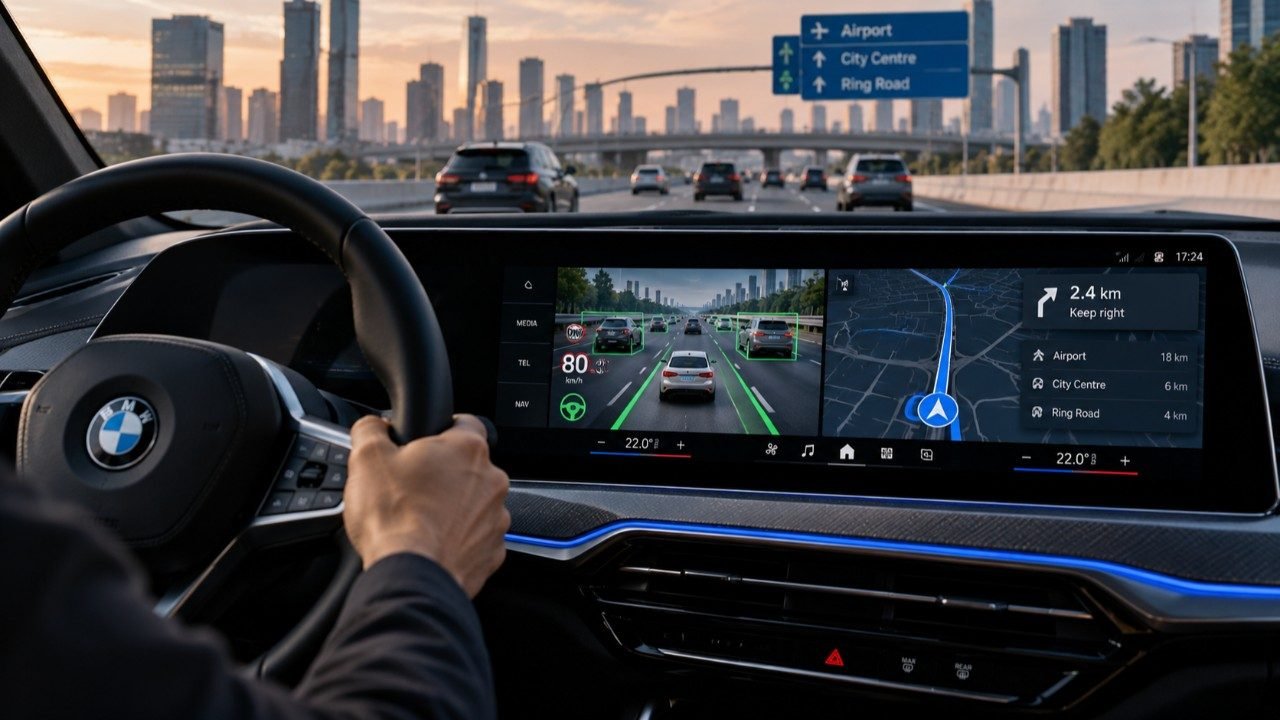
The feature, called BMW Maps with Driver Assistance, combines route guidance, a live rendering of the vehicle's surroundings, and driver-assistance status into a single central display. BMW Group built the system in-house, drawing on navigation data and mapping technology from Mapbox, and it's rolling out on vehicles equipped with BMW Operating System X — initially the i3, iX3, X5/iX5, and 7 Series/i7.
Solving A Genuinely Common Cognitive Problem
Here's the actual issue this update addresses. Most cars with advanced driver-assistance systems split information across two separate displays — one showing your navigation route, another showing what the car's sensors currently perceive around it: nearby vehicles, lane boundaries, upcoming obstacles. Reading both simultaneously means constantly shifting visual attention between two different representations of the same physical space, at exactly the moment a driver needs to process information quickly.
BMW Maps with Driver Assistance collapses that into one continuous 3D scene. The display shows the vehicle positioned precisely in its correct lane, at the correct road level, layered directly against the route guidance — turning what used to be parallel processing across two screens into a single, unified view.
Why This Matters More As Cars Get More Autonomous
The integration becomes genuinely functional, not just visually tidy, once paired with Highway Assistant 2 — BMW's system enabling hands-free highway driving at up to 130km/h, including automated lane changes the car executes after the driver glances to confirm. With the merged view, a driver can actually see why the car is about to change lanes, rendered in the same spatial context as the route ahead, rather than needing to infer intent from a smaller, separate indicator.
That distinction matters increasingly as automated driving features expand. BMW has confirmed that from 2027, Operating System X models will extend navigation-guided, semi-automated driving into urban areas, starting in Germany — a genuinely more complex environment than highway driving, where intersections, pedestrians, and rapidly changing traffic conditions make clear driver communication considerably more important than on a straight motorway stretch.
What BMW's Leadership Said About The Bigger Picture
Stephan Durach, Senior Vice President of Digital Services, Infotainment and Connected Company at BMW Group, framed the update as foundational rather than cosmetic: "An important step toward highly automated driving is the intelligent interaction between navigation and driver assistance. BMW Maps with Driver Assistance shows drivers how route guidance, environmental perception, and assistance functions work together."
Mapbox CEO Peter Sirota echoed that framing from the technology partner's side, describing the collaboration as bringing "this next-generation navigation experience to market" for the first time, with drivers able to "see exactly which lane they need to be in and everything happening around the vehicle" in one seamless view.
The Trust Problem This Is Actually Trying To Solve
Here's the deeper issue worth understanding. As driver-assistance systems take on more of the actual driving task, driver trust becomes a genuine bottleneck to adoption — not a technical limitation, but a psychological one. A system that makes confident, correct decisions but never explains its reasoning to the driver tends to generate anxiety and second-guessing, even when the underlying technology works reliably.
By visualising exactly what the car perceives and why it's making specific decisions, BMW is betting that transparency itself builds the confidence needed for drivers to genuinely rely on increasingly automated systems — treating explainability as a feature in its own right, not just an engineering afterthought.
Rollout Limitations Worth Knowing
The feature requires an active Highway Assistant or Highway & City Assistant subscription and is rolling out in phases across select countries, cities, and roads — not a simultaneous global launch. Availability depends on regulatory approval in each market, local map data quality, and the pace of BMW Operating System X adoption across the model range, meaning the experience described here won't be uniformly available everywhere at once.
Why This Fits A Broader Industry Pattern
BMW's move here sits alongside a wider shift we've tracked across the industry — Hyundai's Pleos Connect, Mahindra's MAIA architecture, and MG's ADAPT platform all reflect the same underlying trend: automakers treating software and connected features as an ongoing product, refined and expanded well after a vehicle first ships, rather than a fixed capability locked in at the factory. BMW Maps with Driver Assistance is a specific, concrete example of that philosophy applied directly to one of the more genuinely difficult problems in automated driving — not the sensors or the algorithms, but making the machine's reasoning legible to the human still ultimately responsible for the drive.
Have a tip on India's auto and EV space? Write to us at contact@techyrobber.com