
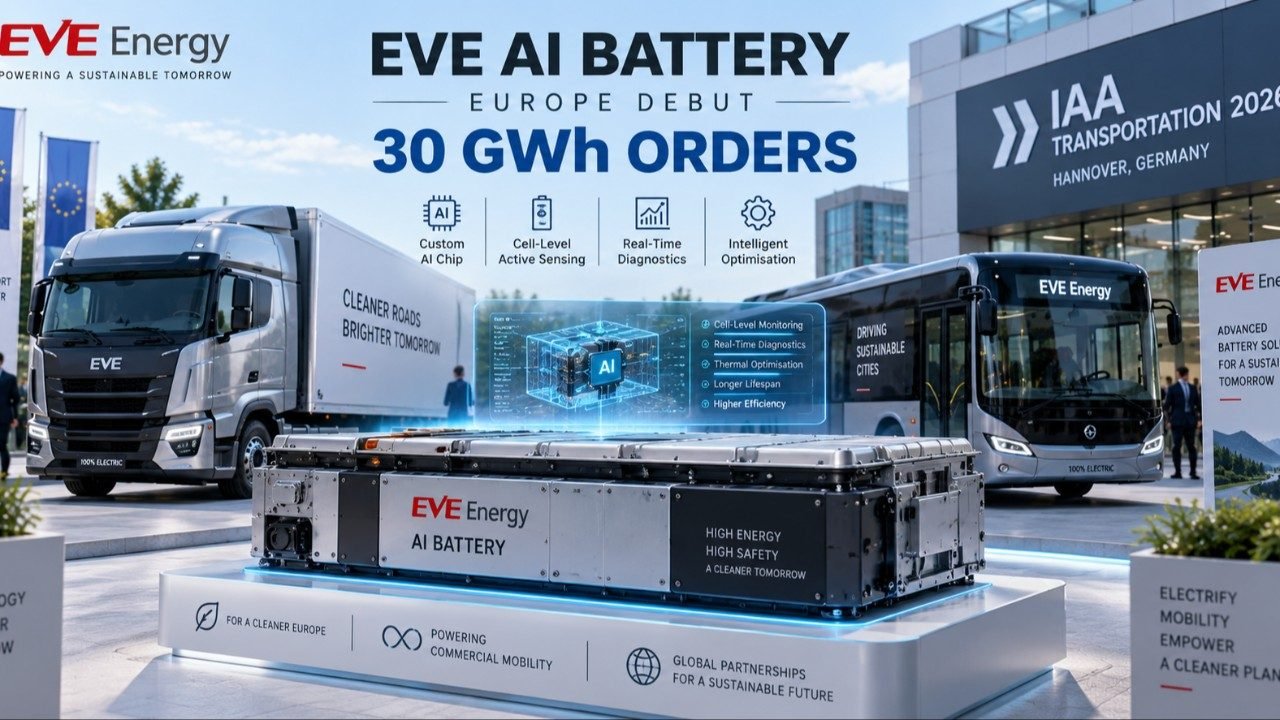
Most conversations about "AI in cars" focus on the cabin — voice assistants, driver monitoring, navigation. EVE Energy is pushing the AI conversation somewhere less visible but arguably more consequential: directly into the battery cell itself. The Chinese battery maker's Open Source Battery 4.0, branded the AI Battery, made its European debut at IAA Transportation 2026 in Hannover, and walked away with strategic cooperation orders exceeding 30 GWh signed on-site.
What Makes This Battery Genuinely Different
Here's the core technical claim worth understanding. EVE Energy's AI Battery integrates a custom-built AI chip directly at the cell level, enabling active sensing, real-time diagnostics, and intelligent optimisation — a meaningful departure from how battery management systems have traditionally worked. Conventional battery management is largely passive: it monitors basic parameters like voltage and temperature and reacts to problems after they occur. EVE's pitch is a battery that actively senses its own condition continuously and adjusts behaviour proactively, rather than waiting for a fault to trigger a response.
The system reportedly works by collaborating with cloud-based AI models for deeper analytical processing — building what the company calls an "Energy Map" to customise optimal power strategies for each specific trip, while continuously learning individual driving habits and road conditions to refine performance over time. That's a genuinely different framing from a static battery spec sheet: the battery itself becomes something that improves with use, similar to how software-defined vehicles evolve through updates, rather than staying fixed at whatever performance it shipped with.
The Technology Underneath the AI Layer
Beyond the AI integration, EVE showcased its underlying LMX chemistry cell lineup — the LM815, LM285, and V63 — alongside a 641kWh underfloor battery system specifically engineered for heavy-duty trucks, and a separate B3E-LF206S system built for buses. The company describes LMX chemistry as retaining the high safety and thermal stability characteristics inherent to LFP (lithium iron phosphate) material, while pushing energy density higher and significantly improving low-temperature performance — a genuinely important consideration for commercial vehicles operating across Europe's varied climate conditions, from Mediterranean heat to Scandinavian winters.
Who's Actually Signing On
The 30 GWh in strategic cooperation agreements signed at the event came from partners including BMZ, Janus Electric, Morris Commercial, Sunswap, and WEG — a genuinely diverse list spanning different corners of the commercial EV ecosystem, from battery pack integrators to specific vehicle manufacturers. That breadth suggests EVE's pitch is resonating across multiple parts of the commercial vehicle supply chain simultaneously, rather than landing with just one type of customer.
Why Europe's Commercial Vehicle Market Specifically Needs This
Here's the market context that explains why EVE chose this specific event and region for the European debut. Electrification of commercial vehicles across Europe continues accelerating, but the market imposes genuinely demanding requirements: stringent regional regulations, and highly varied cross-border operating conditions that traction batteries must handle reliably across full lifecycle economics — not just performance in ideal lab conditions.
A truck running long-haul routes across multiple European countries faces genuinely different demands than a bus operating fixed urban routes, or a delivery van handling short, frequent stops. A battery system that actively adapts its power strategy based on real usage patterns, rather than running one fixed profile regardless of application, is directly responsive to that operational diversity.
Why This Approach Fits a Broader Industry Pattern
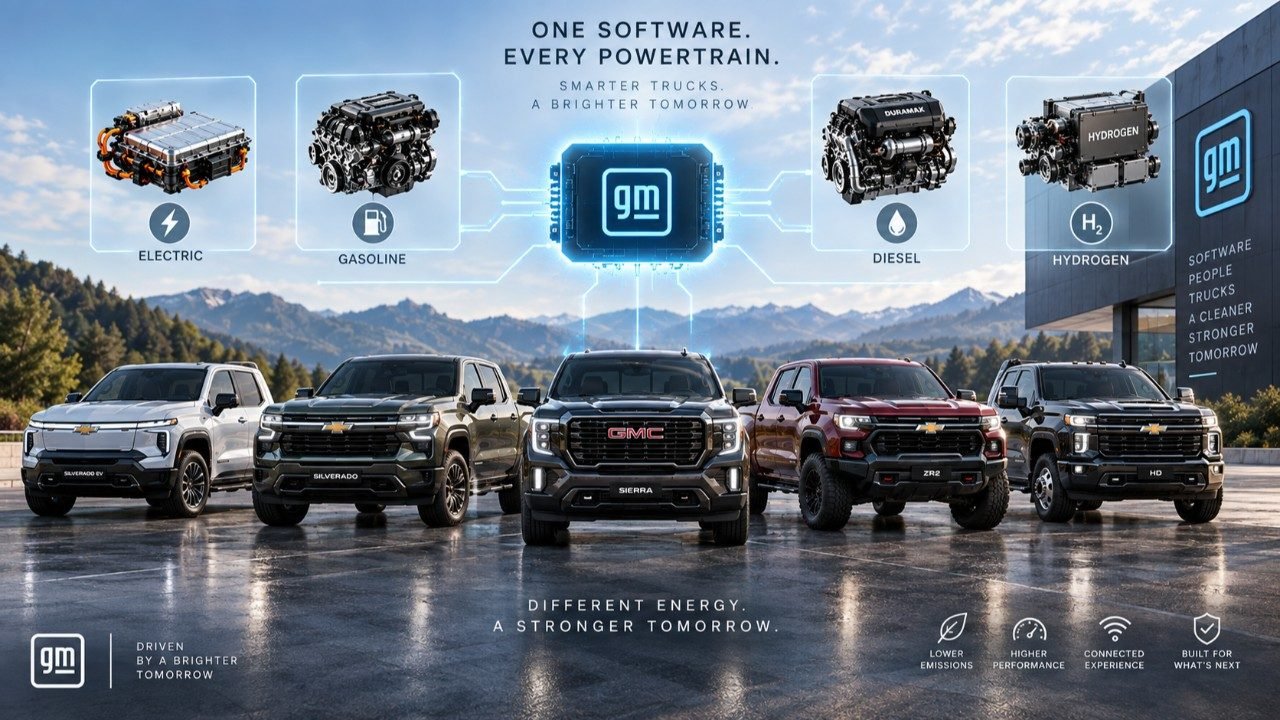
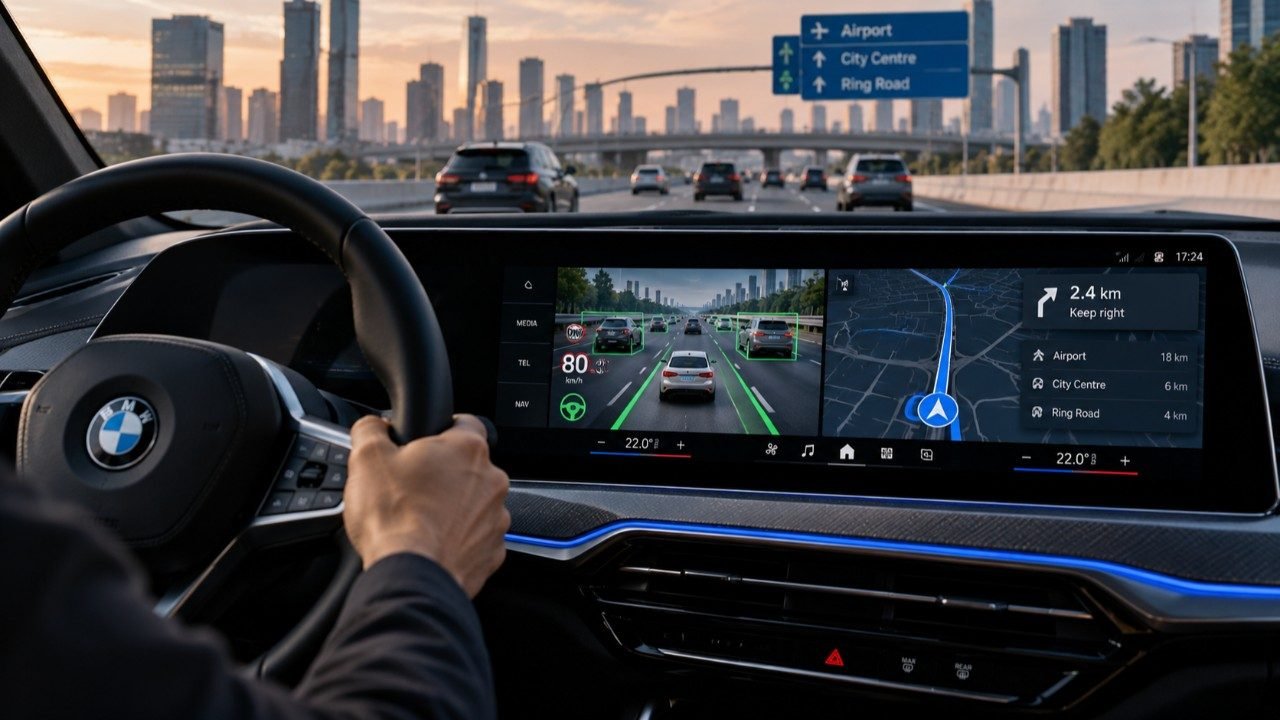
Here's the connection worth drawing to what we've covered elsewhere. This is the same underlying philosophy behind software-defined vehicles more broadly — Hyundai's Pleos Connect, Mahindra's MAIA, GM's unified truck platform, BMW's Maps and Driver Assistance system all reflect a shift toward systems that continue learning and improving after deployment, rather than shipping with fixed, unchanging capability. EVE is applying that same logic to the battery itself, arguably the single most expensive and safety-critical component in any EV — treating it as something that gets smarter over its service life, not just a fixed chemical energy store.
What This Means for the Broader EV Supply Chain
For fleet operators specifically, the pitch is fairly direct: better diagnostics mean fewer unexpected failures, adaptive power strategies mean better real-world range and efficiency without manual tuning, and self-learning systems mean the battery's performance profile actually improves as it accumulates real operational data rather than degrading purely with age and cycle count.
Whether EVE's AI Battery delivers on these claims at the scale the 30 GWh in signed orders implies will become clearer as these partnerships move from agreements into actual deployed fleets across Europe's commercial vehicle networks. But the debut itself signals something worth watching: as electrification matures beyond the "does this technology work" phase into genuine fleet-scale deployment, the next competitive battleground may increasingly be intelligence embedded directly in the energy source itself, not just the vehicle wrapped around it.
Have a tip on India's auto and EV space? Write to us at contact@techyrobber.com