
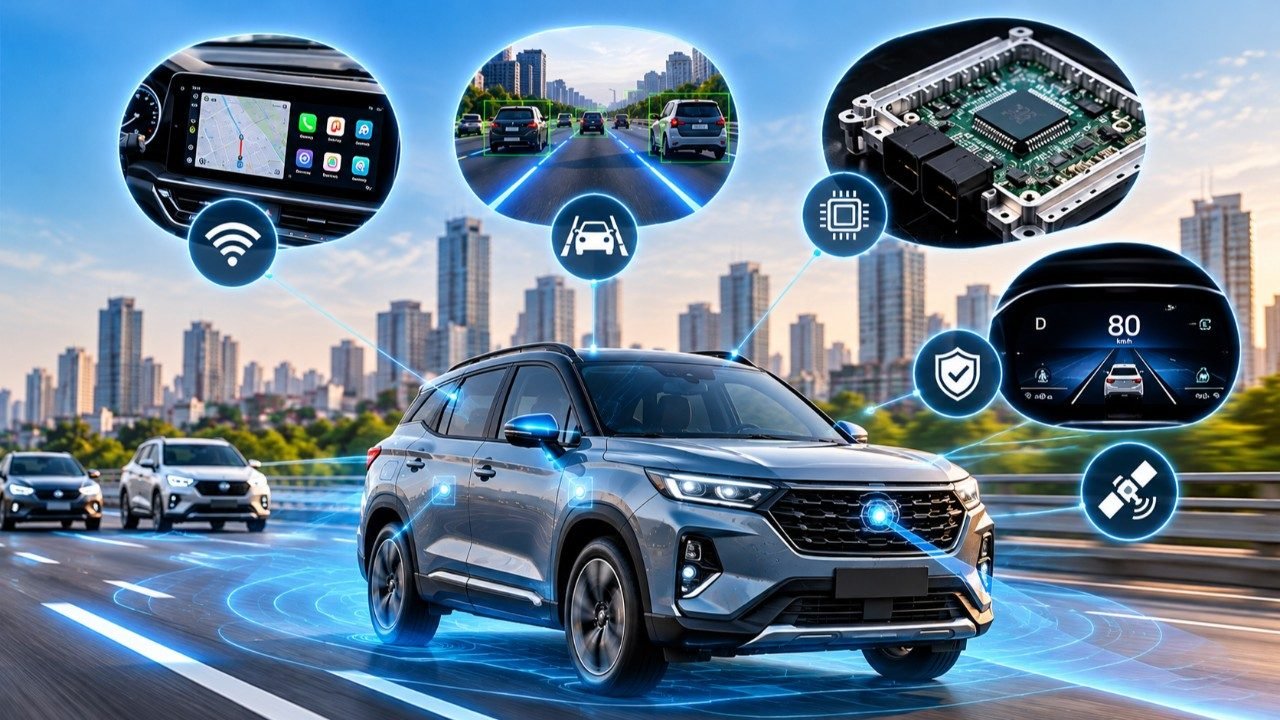
Current automobiles are no longer defined merely by their engines and systems that run them. Today’s automobile experience consists of advanced electronic technology that involves numerous cameras, radars, sensors, processors, control units, and fast communication networks. These innovations make collecting and processing data continuously possible in order to run several functions that involve automatic emergency brakes, intelligent navigation, battery management, assistance for drivers, and remote software updates. As automobiles are becoming more electric-operated and connected, automotive electronic systems become one of the important bases for automobile development.
This situation means not just that automotive electronics change but that new possibilities for technology evolve. Dataintelo’s report shows that the global automotive electronics industry reached approximately $238.5 billion as of 2025 and will reach around $447.0 billion approximately by 2034, increasing at a compound annual growth rate of around 7.2% from 2026 to 2034. This growth happens because of the growing necessity for advanced safety systems, vehicle platforms, computer technologies, etc.
Why Indian Roads Need Smarter Cars
Looking at India’s road-safety data shows that smart vehicle electronics are very important. The Ministry of Railways and Transport (MoRTH) found that in 2022, 461,312 accidents happened, and 168,491 people died. The average deaths were about 462 daily. Out of all the deaths, 71.2% resulted from speeding, and most of the deaths occurred on rural roads (about 68%), which shows the need for intelligent vehicle speed alert systems, automatic emergency braking systems, stability control systems, and driver-monitoring systems.
Vehicles traveling at high speeds have another issue to deal with. National highways and expressways accounted for 151,997 accidents and 61,038 deaths, which account for 36.2% of the total deaths. Uttar Pradesh had 22,595 deaths, and Tamil Nadu had 17,884 deaths, which makes up for 24% of the total deaths. Almost 20% of the victims were pedestrians; therefore, systems such as radar, cameras, and pedestrian-detection applications can be very helpful in increasing road and vehicle safety.
The Electronics Powering Modern Vehicles
Hardware still carries most of the weight. Sensors hold the largest component share at 32.6%, worth about $77.8 billion in 2025, followed by electronic control units at 28.4%, or $67.7 billion. Current carrying devices account for 18.9%, and other components make up 20.1%. Sensors lead because every safety feature needs eyes, from ultrasonic parking sensors to radar units operating around 77 GHz.
| Component | 2025 Share | Approx. Value |
| Sensors | 32.6% | $77.8 billion |
| Electronic control units | 28.4% | $67.7 billion |
| Current carrying devices | 18.9% | $45.1 billion |
| Others | 20.1% | $47.9 billion |
From Dozens of Controllers to Centralized Computing
The biggest innovation is architectural. Premium vehicles have often carried well over 70 separate electronic control units, each with its own software and wiring. Automakers are consolidating them into a handful of domain and zonal controllers. As an illustration, moving from 70 controllers to 5 would cut controller count by about 93%, along with the connectors and software variants attached to each one.
The data backbone is changing too. Classical CAN bus tops out at 1 Mbps, while automotive Ethernet under IEEE 802.3bp reaches 1 Gbps, a 1,000-fold jump that makes high-resolution cameras and real-time sensor fusion possible.
Key shifts behind this smarter architecture include:
- Centralized computing replaces dozens of isolated controllers with a few high-performance chips.
- Software-defined features can be added after purchase, extending a vehicle's useful life.
- Over-the-air updates remove the need for many workshop visits.
Smarter Powertrains Are Already on Indian Roads
The recent introductions in India show that electronics are available in all price categories in the auto industry. Now, the Mercedes-Maybach S 580e can be bought for the price of Rs 3.35 crore (plug-in hybrid) and boasts about 580 hp and a reach of 98 km. And on the opposite side of the spectrum, the Ampere Nexus EX+ has been launched for Rs 1.30 lakh, providing a capacity of 5 kW and an LFP battery. Moreover, Suzuki comes up with a 1.2-litre turbo engine having ability of 126 hp. This latest engine runs on petrol, E100 ethanol, CNG, and biogas. All these technologies make use of power electronics and software technology resulting in smooth flow of energy.
There are advantages of volume. The total sales of two-wheelers reached 17,90,188 units in September this year. This means that 1% of the total number equals approximately 17 900 riders on the road, who get the facility of advanced features like electronic brakes, traction control, etc.
How Electronics Are Improving Vehicle Safety
A global standard indicates what the persistent expenditure can result into. The US National Highway Traffic Safety Administration believes that 39,345 people died in transport accidents in the US in 2024, which is a 3.8% drop from the number of 40,901 in 2023. The death rate decreased to 1.20 per 100 million of vehicle miles traveled, the lowest figure since 2019. Although electronics are not the only factor, a lot of systems depend on fast and precise detection, like stability control and automatic emergency braking.
The drop shows a possible positive effect of the combination of factors connected to car safety, road infrastructure, law enforcement and technologies. The role of electronic equipment is of great significance in the context of safety systems.
Standards of engineering allow measuring this reliability. ISO 26262 introduces four ASIL levels, from A to D, and the functions that are regarded as safe have to be at the highest level. For instance, the chips that have been evaluated according to the AEC-Q100 Grade 0 standard should work in the temperature range from -40 to 150 degrees Celsius, which is much broader than the range of many devices for consumer needs.
Connected Cars Become Networked Devices
Compared to 4G responses that take several milliseconds, the latency rate of 5G connections is much lower, which is important in case of unexpected situations that vehicles may run into. The V2X technology allows vehicles to exchange the data on their positions, speed, and current braking status. Systems equipped with C-V2X technology can receive messages with the frequency of 10 times per second.
Let’s see what that means in numbers: if 10 messages are sent each second, it comes to 600 messages per minute or 36,000 messages per hour. Let’s take a junction where 50 vehicles use this technology, and the numbers can grow up to 30,000 messages per minute. Thus, only fast networks and powerful onboard processors will be able to cope with such flow of data.
Current features that are revolutionizing vehicle ownership now include:
• Remote diagnostics tracking problems before occurrences of defects.
• Real-time navigation with traffic and charging information.
• Emergency call systems that automatically send signals with the location after an accident.
Where Automotive Electronics Growth Is Concentrating
All companies across the industry will not participate equally in achieving the high growth figures in revenues. If sensor shares in 2025 are maintained, revenue from the sensor market will grow from $77.8 billion to approximately $145.7 billion, while electronic control units will rise from $67.7 billion to around $127 million. This is just an example and not a forecast, but it explains the motivation for chip producers, sensor suppliers, and software firms in pursuing growth in the same market. Indeed, one out of every three dollars in this total market belongs to the sensors.
The Challenges Ahead
More connected code means a larger attack surface. UN Regulation No. 155 made cybersecurity management mandatory for new vehicle types from July 2022 and for all new vehicles produced from July 2024 in adopting markets. Supply chains remain another risk, since a single vehicle may need hundreds of semiconductor devices from multiple suppliers. Electric vehicles raise the stakes further, because battery management, charging control and thermal systems add several more safety-critical controllers.
The Next Stage of Automotive Electronics
The success of future vehicles hinges on the degree to which electronics, software and connectivity are integrated. Centralized computing allows for the simplification of vehicle architecture, whereas sensors and real-time processing enhance the responsiveness of safety systems. With over-the-air updates, vehicles can be improved continuously, while cybersecurity will gain a new level of importance as more systems are connected.
In India, what this means is that technology can be beneficial beyond the sphere of luxurious vehicles. Effective driver assistance, electronic safety systems, connected services, and intelligent power management make it possible to benefit from advanced automotive technologies in more affordable vehicles.