
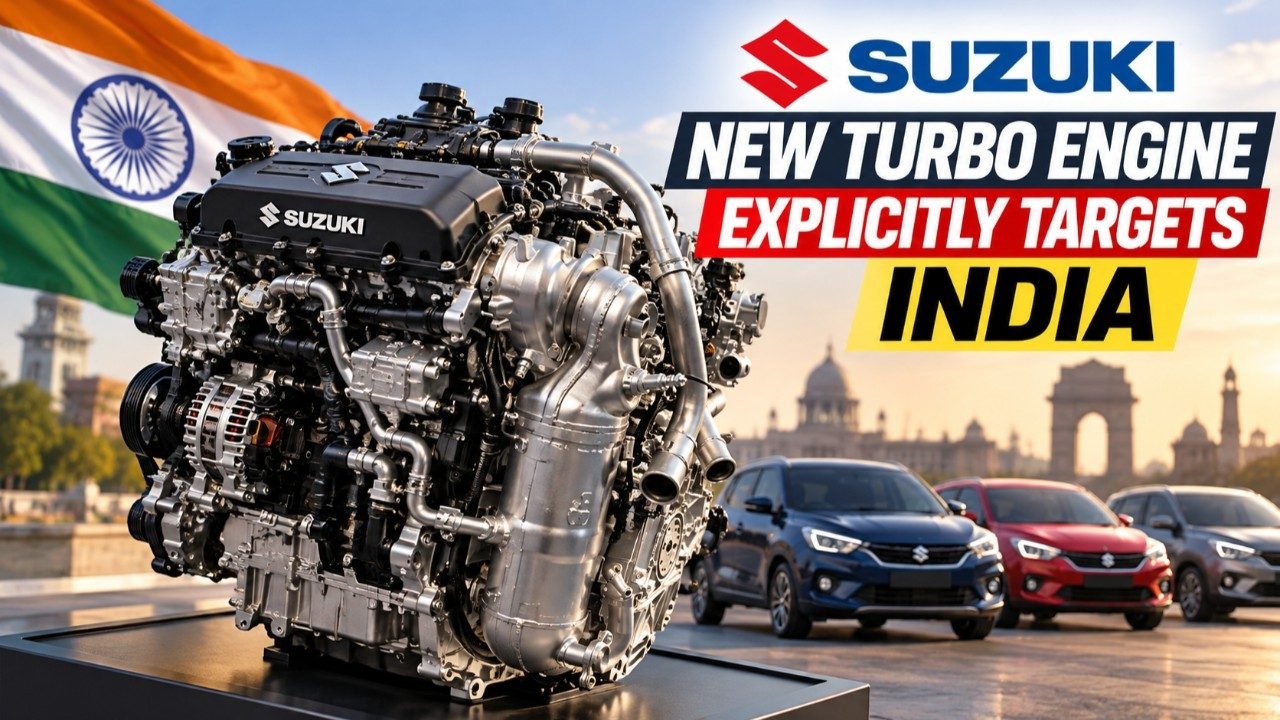
Suzuki has revealed engine specifications that carry a genuinely unusual level of directness about where they're headed. As part of its "Technology Strategy 2026: Looking 10 Years Ahead" roadmap unveiled in Japan, the company confirmed it is developing a new direct-injection turbocharged (DITC) engine specifically "for growth markets such as India."
What The Engine Actually Does
The 1.2-litre, three-cylinder DITC prototype produces up to 126hp and 230Nm, built on the existing Z12E architecture already used across Maruti Suzuki's India lineup — the same base engine currently running in the Swift, Dzire, and Baleno. Suzuki is targeting thermal efficiency of up to 50% by 2035, a genuinely ambitious figure for a small-capacity turbo-petrol unit, achieved by minimising engine-related losses rather than simply adding more boost pressure.
A larger 1.5-litre, four-cylinder turbo-petrol variant is also in development, targeting up to 160hp and 280Nm — a figure that would give Maruti Suzuki a genuinely more powerful petrol option than anything currently in its SUV lineup. For context, the Grand Vitara's current 1.5-litre petrol produces roughly 103hp, meaning this new engine could represent a substantial performance step up if it eventually reaches an Indian model.
Why The Fuel Flexibility Is The Real Story
Here's the detail that matters more than raw output numbers. Both engines are being developed for compatibility with E100 flex fuel, CNG, and CBG (compressed biomethane gas) — not as an afterthought variant, but as a core design requirement from the outset. E100 support means running on 100% ethanol, going meaningfully further than the E20 blend India currently targets, positioning these engines well ahead of where the country's own ethanol-blending programme currently stands.
That timing isn't coincidental. CNG vehicles already account for roughly 40% of Maruti Suzuki's India sales, and the company has separately invested in compressed biogas production domestically — creating a direct link between its existing CNG customer base and future CBG utilisation using the same fuelling infrastructure those customers already rely on.
A Hybrid System Alongside The Turbo Programme
Suzuki also showcased a series-hybrid powertrain based on the same Z12E 1.2-litre architecture, alongside a smaller 0.66-litre three-cylinder engine aimed at future kei-car development. Some reporting on the hybrid system points to combined output as high as 174hp, though exact configuration details for how that would translate to an India-market vehicle remain unconfirmed.
Why Building On The Z12E Base Matters
Choosing to develop these new engines around the Z12E, rather than an entirely new architecture, is a deliberate manufacturing decision. Maruti Suzuki has already been migrating its hatchback and compact sedan range onto Z12E power — Swift, Dzire, and Baleno already run it, with the WagonR expected to follow in an upcoming facelift. Building the new turbo and hybrid variants on that same foundation means Suzuki can leverage existing production tooling and supplier relationships rather than starting from scratch, a genuinely faster and cheaper path to actually getting these engines into Indian showrooms once ready.
What Remains Genuinely Unconfirmed
Worth being precise here: no specific Maruti Suzuki model has been confirmed to receive either engine yet. The Brezza is a plausible application for the smaller DITC unit given its current positioning, and the Grand Vitara or a future SUV could reasonably house the larger 1.5-litre turbo, but these remain informed speculation based on segment fit rather than anything Suzuki has officially announced.
Why This Roadmap Matters Beyond The Specs Themselves
Suzuki explicitly naming India in its own 10-year global technology strategy — rather than India simply being an eventual export destination for global engineering — signals the country's genuine importance to the company's broader product planning. Combined with the intercooler specifically engineered for hot operating conditions "such as India," this reads as engineering built with Indian climate and fuel realities in mind from the design stage, not adapted after the fact.
For Maruti Suzuki specifically, this roadmap points toward a genuinely wider spread of future powertrain choices — stronger turbo-petrol performance, broader alternative-fuel compatibility, and hybrid options — all while keeping the affordability focus that's defined the brand's India strategy for decades.
Have a tip on India's auto and EV space? Write to us at contact@techyrobber.com