
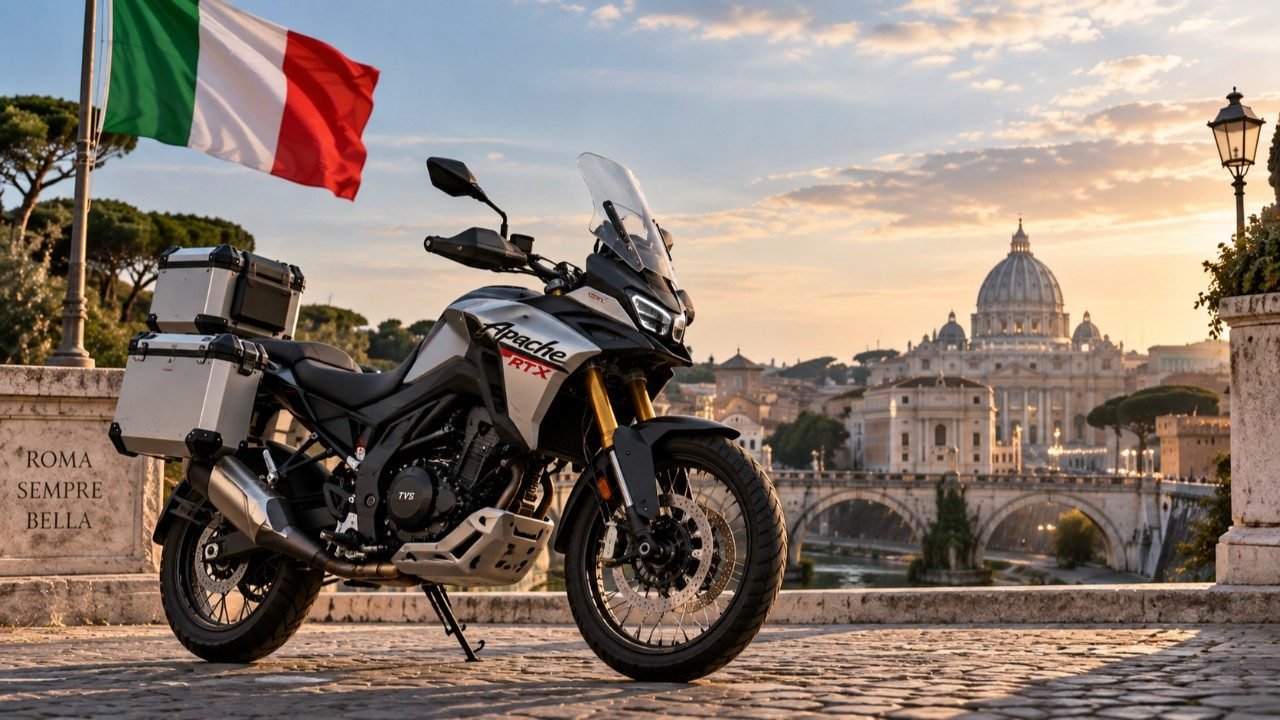
TVS Motor has taken its adventure tourer to one of the most demanding motorcycle markets in the world, and the pricing gap tells its own story. The Apache RTX 300 has launched in Italy starting at €4,890, translating to roughly Rs 5.43 lakh — nearly three times the Rs 1.99 lakh starting price the same motorcycle commands in India.
Sales begin in Italy from November, distributed through around 150 outlets including multi-brand dealerships. TVS Premium Business Head Vimal Sumbly announced the launch directly on social media.
Why The Price Gap Isn't the Real Story
Here's the context that matters before anyone reads too much into that near-tripled price tag. European pricing carries considerably higher taxes, homologation costs, and market-specific regulatory compliance than India's — the same bike genuinely costs more to legally sell and support in Italy, independent of what TVS itself charges as a base price. This isn't TVS marking up an identical product; it's the real cost structure of entering a mature European market.
What's genuinely significant is that TVS chose to launch in Italy at all — a country that's home to Ducati, Aprilia, and MV Agusta, brands with motorcycling heritage stretching back generations. Positioning an Indian-built adventure tourer directly against that competitive backdrop is a considerably bolder move than launching in a market with less established motorcycle culture.
What's Actually Under the Bodywork
The Italian-spec RTX 300 keeps the same fundamental formula that's worked in India: a compact adventure tourer with a substantial stance, upright riding position, and styling that gives it presence well beyond its actual size. Power comes from TVS's 299cc single-cylinder RT-XD4 platform engine, producing 35.5PS and 28.5Nm, paired with a 6-speed gearbox featuring a bi-directional quickshifter.
For European touring specifically, TVS has equipped the bike with a windshield, knuckle guards, and rear luggage mounting provisions, with accessories including side panniers, a top box, tank guard, bash plate, and raised fender all available in the European market.
Why This Isn't Simply an Export
Here's the detail that separates this from a routine international rollout. TVS developed the RT-XD4 platform specifically with global markets in mind from the outset — the RTX 300 represents the company's first serious adventure-touring offering built for international riders, not an India-first product later adapted for export.
That distinction matters strategically. Products engineered from the ground up for global markets tend to compete more credibly against established international rivals than products retrofitted after succeeding domestically. TVS appears to have taken the harder, more expensive route of building genuinely global-spec engineering into the RT-XD4 platform from day one.
Where This Fits Into TVS's Broader Expansion
Italy isn't an isolated bet. TVS has indicated the RTX 300 will eventually reach many of the 80-plus countries where the brand already has a presence, including Germany, South Africa, Argentina, Brazil, Colombia, Mexico, Turkey, Indonesia, Malaysia, and Thailand. A potential North American entry would run through Norton USA LLC, incorporated in Delaware as a subsidiary of Norton UK — though that presence remains very early-stage.
This international push sits alongside other recent TVS moves we've tracked, including the company's strong domestic sales performance and its broader push into electrification. Taken together, the pattern points to a company deliberately building parallel growth engines — domestic volume, export markets, and premium global product lines — rather than depending on any single strategy to drive its next phase of growth.
What the Italian Launch Signals for India
For Indian motorcycle enthusiasts, an India-built adventure tourer launching successfully in Ducati and Aprilia's home market carries genuine symbolic weight beyond the sales figures themselves. It suggests Indian two-wheeler engineering has reached a point where it can credibly compete on design, feature set, and riding experience in markets that have historically set the bar for motorcycle quality — not just compete on price in developing markets where cost sensitivity favours Indian manufacturing.
Whether the RTX 300 actually succeeds commercially in Italy remains to be seen once November sales begin. But the decision to launch there at all, at a price point that puts it in direct competition with established European rivals rather than undercutting them purely on cost, is itself a meaningful statement about where TVS believes its global positioning now stands.
Have a tip on India's auto and EV space? Write to us at contact@techyrobber.com