
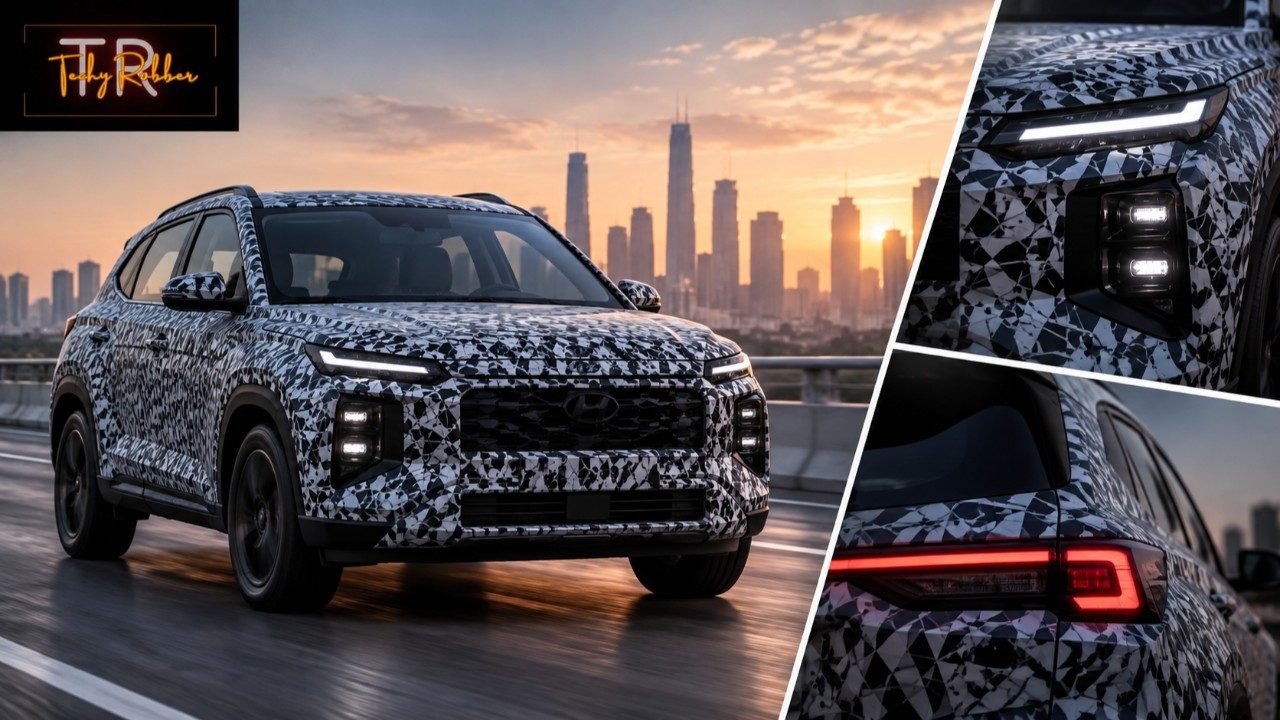
Hyundai's bestselling SUV in India has been spotted testing for months now, but always buried under boxy camouflage that hid nearly every meaningful design detail. That's changed. The next-generation Creta, internally codenamed SX3, has been photographed in Southern Spain wearing just a basic vinyl wrap — the clearest look yet at what Hyundai's replacement for its most important Indian nameplate will actually look like.
Why Southern Spain, Specifically
The location isn't incidental. Hyundai appears to be using the Spanish test session specifically to evaluate hot-weather performance, a genuinely important consideration given how much of the Creta's sales volume comes from markets with extreme summer heat, India chief among them. A towing dyno visible at the rear of the test mule also points to tow-capacity testing and sustained-load performance evaluation — the kind of engineering validation that happens well before a vehicle is anywhere near a final production sign-off.
What the Thinner Camouflage Actually Reveals
With the boxy covering gone, the test mule shows Hyundai's newer "Art of Steel" design language applied to the Creta for the first time — sharper, more angular surfacing replacing the current model's comparatively softer curves. An upright front fascia and boxier overall silhouette suggest a meaningfully different visual identity from the outgoing generation, rather than an incremental refresh.
Multiple outlets tracking this same test mule report H-styled, top-mounted LED daytime running lights expected to pair with LED projector headlamps flanking a redesigned grille — styling cues that echo Hyundai's global Crater Concept, shown at the 2025 Los Angeles Auto Show, which has been widely cited as a directional preview for this next Creta generation.
A New Platform Sits Underneath
Here's a structural detail that matters beyond styling. Reports point to the next-gen Creta moving onto Hyundai-Kia's K3 platform — the same architecture underpinning the latest Kia Seltos. A shared platform typically brings improved structural rigidity, better cabin packaging, and often a genuine size increase, since newer platforms are usually engineered with more interior space as a priority from the outset.
Consistent with that, reports suggest the new Creta could grow to approximately 4.5 metres in length, up from the current model's 4,330mm — a meaningful jump that would translate into more rear-seat space and likely a larger boot, assuming these figures hold through to the final production vehicle.
The Cabin Gets Hyundai's Newest Software Platform
The next-gen Creta is also expected to introduce Pleos Connect, the same next-generation infotainment system we've covered in detail on the global Tucson reveal and the Kia Sorento's AI Assistant. A primary central screen split into three core functional sections handles infotainment and instrument functions together, paired with a slimmer digital display behind the steering wheel focused specifically on essential driving data like speed and navigation.
That's a meaningful software upgrade path for Hyundai's highest-volume Indian model — bringing the same underlying technology stack we've tracked rolling out across the brand's global and premium lineup down into its bestselling mainstream SUV.
A Strong-Hybrid Option Is Coming
Multiple reports point to a strong-hybrid powertrain joining the next-gen Creta's lineup, likely built around the same 1.6-litre naturally aspirated GDI petrol engine paired with one or two electric motors used in the new global-spec Seltos, depending on variant. Hyundai hasn't officially confirmed power output, battery capacity, or fuel efficiency figures yet — these details should be treated as expected rather than confirmed until Hyundai releases official specifications.
Existing petrol, turbo-petrol, and diesel options are expected to carry over alongside the new hybrid variant, giving Hyundai a genuinely wide powertrain spread on its most important model.
Timing and Competitive Context
Industry expectations point to an early 2027 reveal, with a possible debut at the 2027 Bharat Mobility Global Expo before market launch follows in the first half of that year. The timing matters competitively — the current Creta faces intensifying pressure from the Kia Seltos, Tata Sierra, and upcoming hybrid offerings from JSW Motors and Renault, all closing in on a segment the Creta has dominated for years.
For Hyundai, getting this generational change right carries real stakes. The Creta has been the company's single most important India volume driver for years; a next-generation model that genuinely delivers on size, technology, and powertrain choice could extend that dominance, while a misstep here would open real ground for rivals in India's most fiercely contested SUV segment.
Have a tip on India's auto and EV space? Write to us at contact@techyrobber.com