
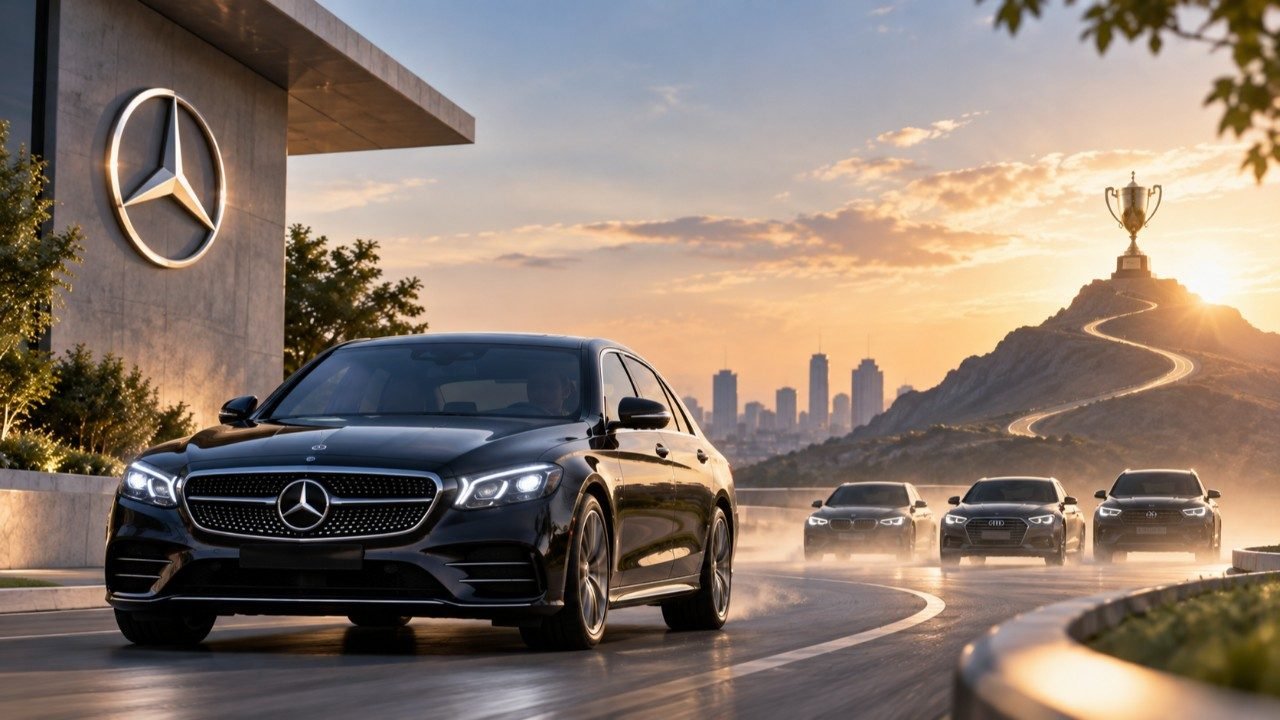
Mercedes-Benz has held the top spot in India's luxury car market since 2015 — a genuinely long run at No.1 by any industry's standards. Now, with that lead narrower than it's ever been, the company's India chief is saying the ranking itself doesn't actually matter to him.
Speaking to ET Auto, Mercedes-Benz India MD and CEO Santosh Iyer pushed back directly on the industry's fixation with sales rankings: "Who is asking us to be volume No 1? Who is asking, except the press, who tries to come up with stories on No 1, No 2, No 3?"
Why This Comment Lands Differently Right Now
Here's what makes Iyer's framing genuinely notable rather than routine corporate messaging. This isn't a comfortable leader dismissing a question about a race it's comfortably winning — BMW has already moved ahead of Mercedes-Benz on VAHAN retail registrations in the first half of 2026, the closest the two brands have been since Mercedes took the top spot from Audi back in 2015.
For context on how much that gap has closed: Mercedes sold 13,502 cars in 2015 against BMW's 6,550 units, a lead of nearly 7,000 units. That gap stayed above 5,000 units through 2018. By 2025, it had shrunk to just 1,736 units. Iyer's comments arrive precisely at the moment that narrowing lead has actually flipped against Mercedes on at least one measurement.
The Reasoning Behind Opting Out of the Race
Iyer's argument rests on a specific structural point: Mercedes-Benz India isn't a listed company, meaning there's no shareholder pressure demanding volume growth as a headline metric the way a publicly traded rival might face. He described chasing the No.1 ranking specifically for its own sake as a "mirage" — something that looks meaningful from outside but doesn't reflect the actual health of the business.
He also pointed to Mercedes' own history as evidence that rankings shift over time regardless of strategy: the brand was once India's third-largest luxury player before eventually climbing to the top. His framing suggests volume leadership should be an outcome of good strategy, not the goal a company organizes itself around.
What Mercedes Is Prioritising Instead
This isn't the first time Iyer has made this argument. In earlier comments to Reuters, he was even more explicit about the specific segment Mercedes has chosen to step back from: "There is a clear price war happening in the entry luxury segment. We have opted out of it and will continue to opt out of it... We will prefer value over volume."
The numbers back up that stated preference. Mercedes' entry-segment sales fell 23% in 2025, even as sales of vehicles priced above Rs 1.5 crore grew 12%, and Mercedes-AMG performance cars grew 34%. The average selling price of a Mercedes in India has climbed to roughly $111,000, up from $98,500 just two years earlier. Despite an overall unit sales dip, Mercedes posted its highest-ever revenue in India that same year — the actual metric Iyer appears to be optimising for.
Why BMW's Approach Looks Different
BMW India, by contrast, posted its highest-ever annual sales in 2025, growing 15% year-on-year to 17,271 units — a strategy that looks considerably more focused on closing the volume gap than Mercedes' current positioning. That's a genuinely different competitive philosophy playing out between India's top two luxury brands in real time: one chasing unit growth across price points, the other deliberately concentrating on its most profitable segments even if that means ceding ground on the topline number.
Why This Debate Matters Beyond Bragging Rights
Sales rankings make for easy headlines, but Iyer's comments highlight a genuine tension in how success gets measured in India's luxury car market. A brand can lose the numbers race while posting record revenue, if its product mix shifts meaningfully upmarket — exactly what's happened at Mercedes over the past couple of years.
Whether that strategy holds if BMW's lead widens further, rather than staying within the roughly 1,700-unit gap seen in 2025, will be the real test of whether "value over volume" remains a comfortable philosophy or becomes a harder position to defend publicly. For now, Mercedes appears genuinely unbothered by ceding the top spot on a metric it's increasingly describing as beside the point.
Have a tip on India's auto and EV space? Write to us at contact@techyrobber.com