
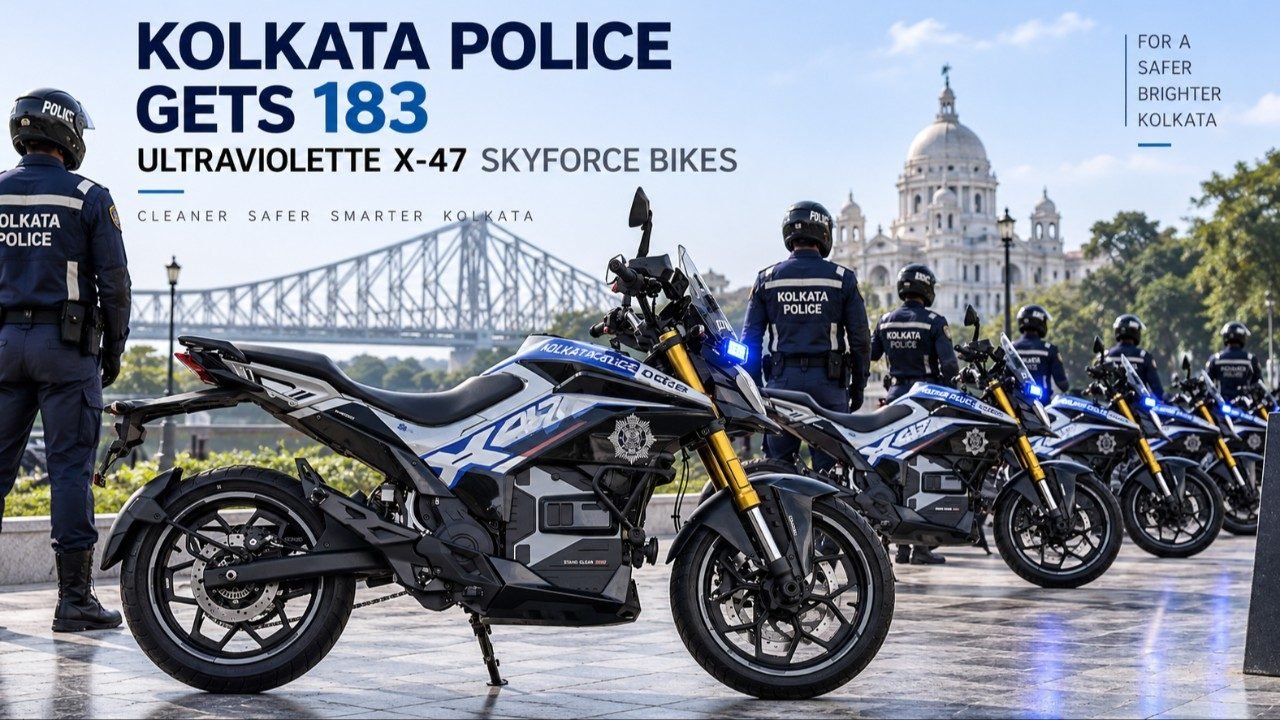
Ultraviolette has moved beyond individual retail buyers into a genuinely different kind of customer: law enforcement. The Bengaluru-based electric motorcycle maker has handed over 183 units of a dedicated police variant, the X-47 Skyforce, to the Kolkata Police — one of the largest electric motorcycle deployments by any Indian police force to date.
The official handover took place at the historic Lalbazar Police Headquarters in Kolkata on September 18. With this deployment, Ultraviolette becomes the first electric two-wheeler manufacturer to have its motorcycles formally inducted into the Kolkata Police fleet.
Why a Purpose-Built Variant, Not Just a Rebadged X-47
Here's what separates this from simply painting an existing motorcycle in police colours. The X-47 Skyforce is built on Ultraviolette's existing X-47 crossover platform, but engineered specifically for police operations with an upgraded electronic architecture designed to support a wide range of integrated law-enforcement equipment — the kind of tactical hardware a genuine patrol vehicle needs that a standard consumer motorcycle simply doesn't account for.
That distinction matters. A police motorcycle isn't just a civilian bike with different paint — it needs mounting points and electrical capacity for radios, lighting systems, and other operational equipment, along with the durability to handle sustained daily patrol duty rather than occasional recreational or commuting use.
Why Electric Makes Sense for a Police Fleet Specifically
Running costs and maintenance are genuinely significant considerations for any police department operating vehicles across long duty cycles, day after day. According to Ultraviolette, electric motorcycles could meaningfully reduce both compared to a conventional petrol patrol bike fleet — a claim that becomes more credible at genuine scale, where even modest per-unit savings compound significantly across 183 motorcycles running daily patrol duty.
The X-47 platform itself is worth understanding for context. It sits somewhere between a street naked and an adventure motorcycle in character, currently starting at Rs 2.49 lakh, ex-showroom, for the base civilian variant, and offers a claimed IDC range up to 323km on higher-spec versions — genuinely strong range figures that matter directly for a patrol vehicle that needs to stay operational across long shifts without frequent charging interruptions.
Why This Deployment Matters Beyond One City
This isn't Ultraviolette's first attempt to break into institutional and government fleet business, but it's a genuinely significant proof point. Landing a 183-unit deployment with a major metropolitan police force gives Ultraviolette a concrete, large-scale reference case it can point to when pitching other state or city police departments considering similar electrification of their patrol fleets.
For Kolkata Police specifically, the deployment is framed as part of a broader modernisation effort — adopting technology-led solutions for law enforcement rather than simply replacing worn-out petrol motorcycles on a like-for-like basis. That framing signals genuine institutional buy-in to the idea of electric patrol vehicles as a deliberate upgrade, not just a cost-cutting substitution.
Why the Timing Fits Ultraviolette's Broader Trajectory
This deployment lands right alongside other recent Ultraviolette developments we've covered — the company's Rs 779 crore Hosur manufacturing investment aimed at scaling toward mass-market volume, and its upcoming Tesseract scooter and Shockwave motorcycle both targeting sub-Rs 2 lakh price points. Taken together, a pattern emerges: Ultraviolette isn't just trying to sell more premium motorcycles to individual retail buyers, it's actively diversifying into institutional and fleet business simultaneously.
That's a genuinely sound strategy for a company that's been candid about needing more manufacturing volume to hit its growth targets. Large institutional orders — police fleets, potentially delivery or logistics fleets down the line — provide predictable, bulk demand that helps justify the kind of manufacturing scale-up Ultraviolette is currently investing in, rather than depending purely on individual retail sales building up gradually one motorcycle at a time.
What This Means for Electric Two-Wheeler Adoption More Broadly
Government and institutional procurement carries real signalling weight beyond the units sold. When a major metropolitan police force chooses to induct 183 electric motorcycles into active daily patrol duty, it functions as a meaningful public endorsement of electric two-wheeler reliability for genuinely demanding, high-utilisation use cases — not just light urban commuting, which is where EV adoption has concentrated so far.
For Ultraviolette, this Kolkata Police deployment likely serves as the opening chapter in a broader institutional sales push, with other state and city police departments watching closely to see how the X-47 Skyforce actually performs across sustained daily patrol operations before considering similar fleet decisions of their own.
Have a tip on India's auto and EV space? Write to us at contact@techyrobber.com