

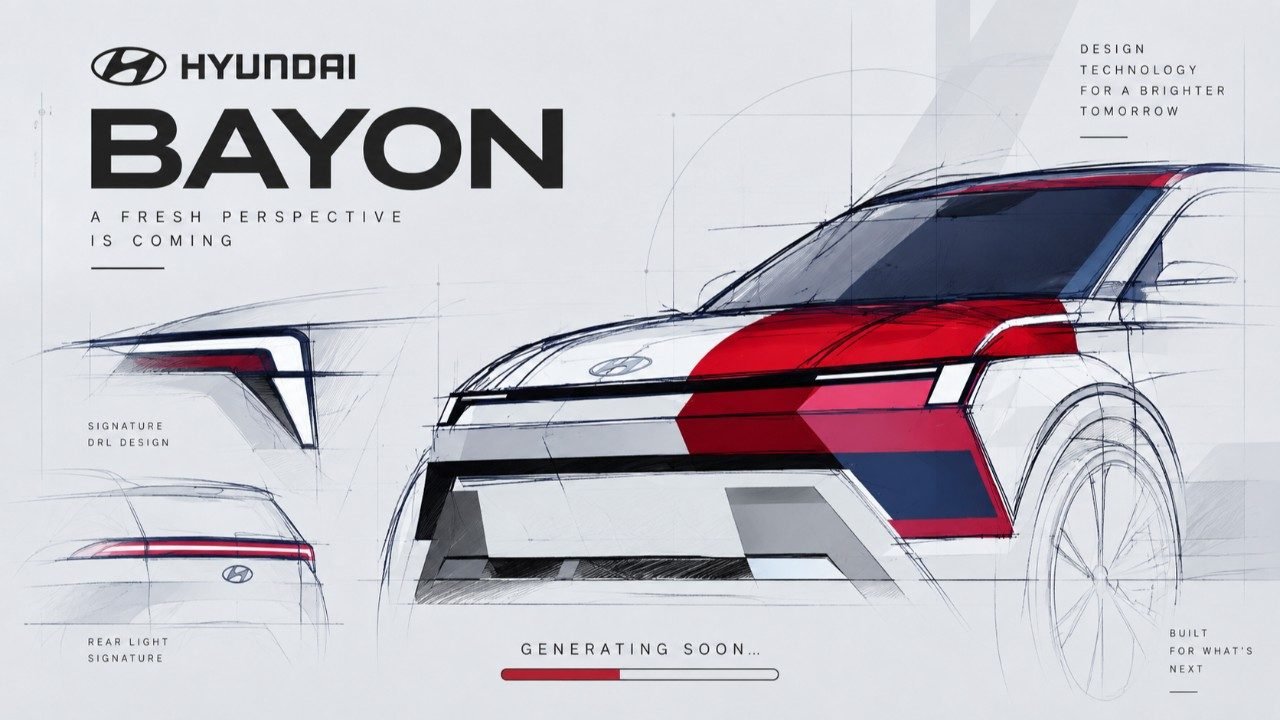
Hyundai has taken the wraps off its next India SUV's design direction, releasing official sketches of the Bayon just days after confirming the model's name. The reveal offers the clearest look yet at a vehicle Hyundai is positioning to slot between the Venue and the next-generation Creta, with a launch targeted for this year's festive season.
What The Sketches Actually Reveal
The exterior sketch shows a wide, upright front fascia built around Hyundai's evolving Art of Steel design philosophy — architectural forms, sharp character lines, and defined proportions. A sculpted hood with pronounced creases, significantly flared front fenders, and Hyundai's distinctive "H-Edge" lighting signature — a horizontal light element stretching across the front paired with prominent vertical elements — combine to give the Bayon genuine visual presence. Substantial lower-body elements, including a skid plate integrated into the bumper, reinforce the SUV character Hyundai is clearly aiming for.
Round the back, the sketches show slim LED taillamps and a roof spoiler. The interior sketch reveals a twin-screen dashboard layout with a central dropdown panel for HVAC controls that notably retains physical dials and knobs — a deliberate choice against the increasingly common trend of moving climate controls entirely into touchscreen menus. A wireless charging pad sits built into the base of a vertically oriented centre console.
Why These Sketches Line Up With What's Already Been Spotted
Here's what gives this official reveal real credibility rather than reading as pure marketing concept art. The design details correlate closely with heavily camouflaged Bayon test prototypes already spotted testing in India — an upright profile, straight roofline, prominent wheel arches, and functional roof rails all match what spy shots had previously suggested. That consistency between official sketches and real-world test mule sightings is a strong signal the production version will closely follow this design direction, rather than the sketches representing an idealised concept that gets watered down before reaching showrooms.
Interestingly, one earlier test mule had carried "BRING IT ON" graphics with the "ON" portion specifically highlighted — speculation at the time suggested this was Hyundai subtly teasing the Bayon name well before the official confirmation. Hyundai formally confirmed the name on September 14 through its "Intelligence ON" campaign, retroactively validating that earlier reading of the camouflage graphics.
Where Bayon Fits In Hyundai's India Lineup
The Bayon is expected to measure over four metres in length, positioning it as something genuinely larger than a conventional sub-4m SUV like the Venue, without stepping all the way up to Creta territory. That's a deliberate gap-filling strategy — giving Hyundai a product for buyers who want more space and presence than the Venue offers, but aren't ready to commit to Creta-level pricing.
What Simon Loasby Said About The Design Intent
Simon Loasby, Senior Vice President and Head of Hyundai Design Center, framed the Bayon's design brief around a specific tension: combining exterior toughness with an interior focused on urban, technology-forward living. His direct quote captures the positioning clearly: the goal was giving Bayon "a character that feels capable, modern and distinctly its own" — explicitly designed for customers who spend most of their time navigating city environments rather than genuine off-road use.
What Remains Genuinely Unconfirmed
Here's where it's important to separate confirmed detail from informed speculation. Hyundai has not released final specifications, dimensions, or powertrain details. Based on prior test mule sightings and industry expectation, a 1.5-litre naturally aspirated petrol engine is considered likely to anchor the lineup, with a factory-fitted CNG variant also possibly joining the range — though neither is officially confirmed.
Expected feature speculation, drawn from spotted test mules rather than official Hyundai statements, points toward wireless Android Auto and Apple CarPlay, ventilated front seats, an electrically adjustable driver's seat, multi-colour ambient lighting, an electric sunroof, connected car technology, and Level 2 ADAS with autonomous emergency braking, adaptive cruise control, lane-keeping assist, and blind-spot monitoring. Six airbags, Electronic Stability Programme, and a 360-degree camera are similarly expected but not officially locked in.
Why Hyundai Is Revealing Design Before Specs
Releasing design sketches well ahead of full specification and pricing details is a common industry tactic for building anticipation gradually — letting the visual identity generate conversation and interest before the more commercially sensitive pricing conversation begins. For the Bayon specifically, entering a genuinely competitive space between two already well-established Hyundai nameplates, building strong design-led anticipation before revealing how it's actually priced against internal and external rivals is a sensible sequencing choice.
Why This Matters For India's Compact SUV Segment
If the Bayon does launch this festive season as targeted, it arrives into one of India's most fiercely contested vehicle segments, sitting alongside the next-generation Creta we've covered separately in its own spy-shot coverage. A genuinely new nameplate, rather than a facelift or variant expansion of an existing model, represents a considerably bigger strategic bet for Hyundai — one that will only become fully clear once specifications, features, and pricing are officially confirmed closer to the actual launch date.
Have a tip on India's auto and EV space? Write to us at contact@techyrobber.com