
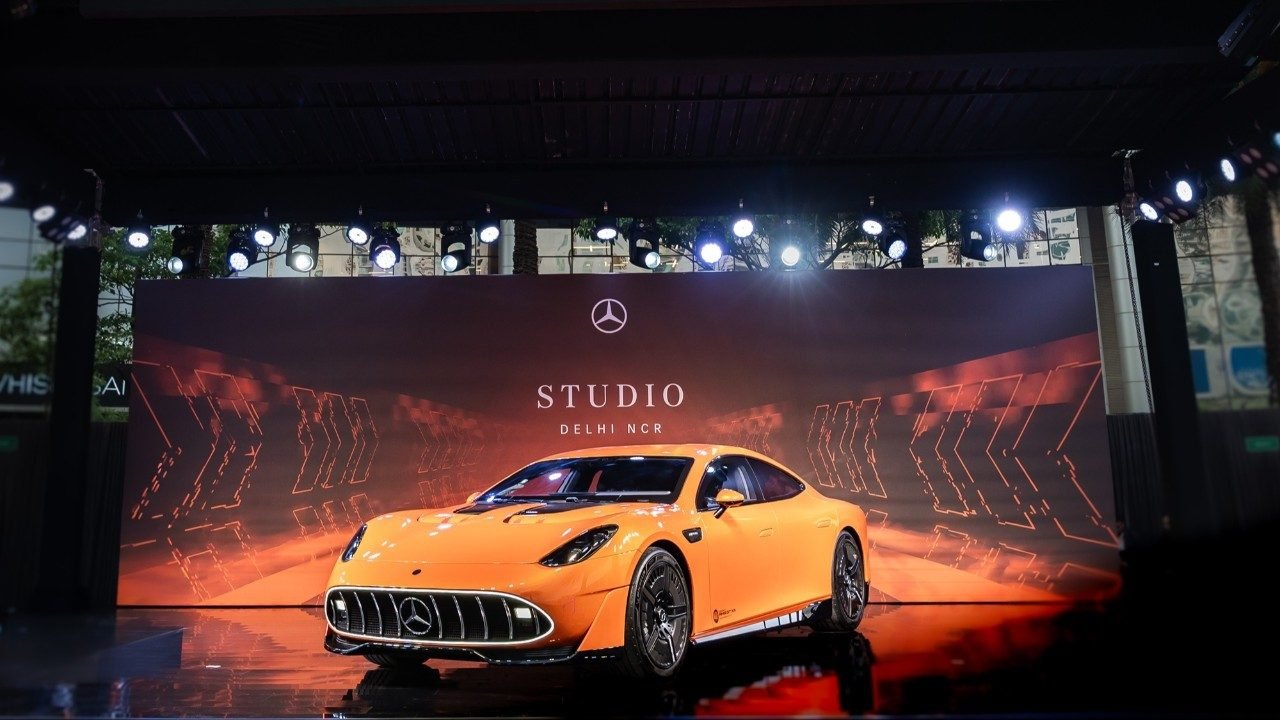
Walk into most car showrooms, and the entire space is designed around one outcome: a sale. Mercedes-Benz India's newest space in Gurugram is built differently. The company has inaugurated the country's first Mercedes-Benz Studio at DLF One Horizon Centre — a format built around café culture, design exploration, and brand immersion, where sales functionality exists but is deliberately kept in the background rather than front and centre.
India now joins just 14 global markets — alongside Copenhagen, Los Angeles, Tokyo, and Singapore — hosting this specific Studio format, a signal of how Mercedes-Benz is positioning the Indian market within its global retail strategy.
What's Actually Inside
The Studio combines a curated vehicle display with a design and material library — letting visitors explore finishes and customisation options the way they might browse fabric swatches, not just glance at a spec sheet. Add to that a Mercedes-Benz lifestyle collection, Mercedes-AMG x adidas merchandise, and a dedicated Lavonne Café, and the space reads closer to a lifestyle boutique than a traditional auto retail floor.
The headline vehicle on display is the Concept AMG GT XX — a four-door EV finished in Sunset Beam Orange, built on Mercedes-AMG's new AMG.EA electric architecture. It's a genuinely serious piece of engineering to anchor a brand-experience space: three axial flux motors combining for 1,341hp, an 800V electrical architecture, and DC charging capable of adding roughly 400km of range in just 5 minutes. This marks the concept's first appearance in Delhi-NCR specifically, with previous Indian showings limited to Mumbai's NMACC.
Why Mercedes Isn't Calling This a Sales Activation
Here's the framing that separates the Studio from a typical showroom opening — though it's worth being precise about what this actually means. Brendon Sissing, Vice President of Sales & Marketing at Mercedes-Benz India, told reporters directly: "This is not really a selling activation." Company materials describe the Studio as combining immersive brand experiences with "integrated sales functionality" — meaning the ability to browse, configure, and eventually purchase a vehicle is genuinely built into the space. What's different is emphasis, not absence: the Studio isn't designed to pressure a visitor toward a same-day sale the way a conventional showroom often is.
The Studio is deliberately open to visitors who aren't currently in the market for a Mercedes at all — success here isn't measured primarily through immediate bookings, but through engagement, curiosity, and a stronger emotional connection with the brand over time.
That's a genuinely different metric than most retail spaces operate on. A conventional dealership's entire layout, staffing, and sales process is built around converting a visitor into a purchase within a single visit or a short follow-up window. The Studio format explicitly steps back from that pressure, betting that a longer, less transactional relationship with the brand eventually pays off in loyalty and consideration, even if it doesn't show up in that week's sales numbers.
Why Gurugram, Specifically
Sissing pointed to a combination of factors behind the location choice: Delhi-NCR's lifestyle positioning, strong footfall, and proximity to Mercedes-Benz's existing retail network in the region. Mercedes already runs brand activations in Mumbai through NMACC, making a second, complementary format in the Delhi-NCR market a logical next step rather than a first experiment.
A Surprising Addition: E-Bikes
Alongside the Studio's inauguration, Mercedes-Benz launched something genuinely unexpected for a luxury car brand: the Mercedes-AMG Petronas F1 Team e-bike range, developed in partnership with EMotorad. The lineup spans three editions — City, Track, and Rallye — priced between Rs 4.20 lakh and Rs 7.60 lakh, built around a 250W rear hub motor with Comfort, Sport, and Sport Plus power modes, and a claimed range of up to 100km. Notably, these e-bikes require no driving licence or registration in India, opening the Mercedes-AMG brand to buyers who'd never actually purchase a car.
Why This Retail Experiment Matters
Luxury automotive retail globally has been shifting away from the traditional showroom-as-sole-touchpoint model for a few years now, as brands compete for attention in a world where customers research, configure, and often decide on a vehicle largely online before ever visiting in person. A Studio format that emphasises experience and brand affinity over immediate conversion is Mercedes-Benz's bet on where luxury retail is heading — treating the physical space as a relationship-building tool rather than purely a transaction point.
Whether this specific format expands to other Indian cities remains unconfirmed; Mercedes-Benz hasn't committed to a rollout timeline beyond Gurugram. But for a market where luxury car ownership carries significant aspirational weight even among people who aren't imminently buying, a space explicitly designed to welcome browsers rather than only serious buyers could prove to be a genuinely effective long-game strategy — one that measures success in relationships built rather than units moved.
Have a tip on India's auto and EV space? Write to us at contact@techyrobber.com