
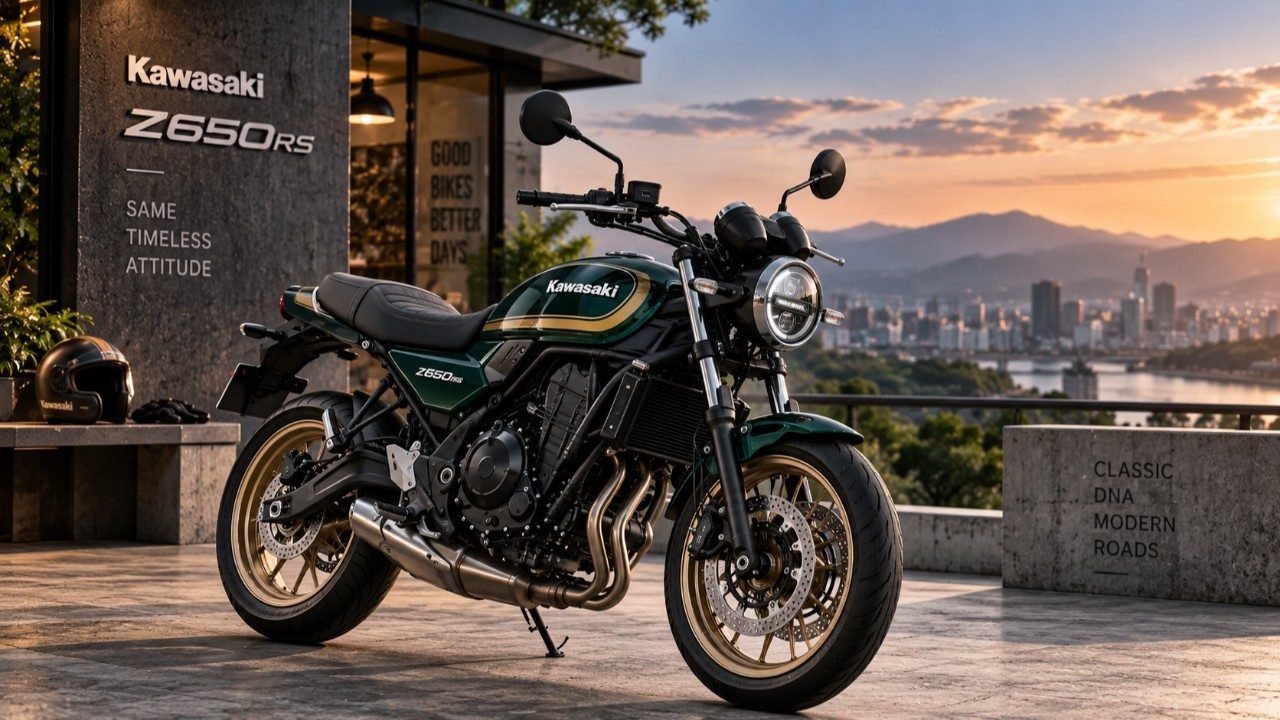
Kawasaki has updated the Z650RS for 2027, and the honest summary is that almost nothing has actually changed. The retro-styled roadster continues at Rs 7.83 lakh, ex-showroom — identical to what the outgoing 2026 model cost — with the sole modification being the model-year badge itself.
A Genuine Carryover, Not Just Marketing Language
Here's what makes this update genuinely minimal rather than just modestly refreshed. Kawasaki hasn't touched the engine, chassis, electronics, or even the colour palette. The Z650RS continues with its 649cc liquid-cooled parallel-twin, producing 68PS at 8,000rpm and 64Nm at 6,700rpm, paired with a 6-speed gearbox featuring an assist-and-slipper clutch. Kawasaki's two-mode Traction Control (KTRC) carries over unchanged, as does the tubular trellis-style steel frame, 41mm telescopic front fork, and horizontal back-link monoshock rear suspension.
Even the single available colour — Metallic Ocean Blue, with golden graphics on the tank and matching golden-finish alloy wheels — stays identical to last year. Dimensions and weight are untouched too: 800mm seat height, 1,405mm wheelbase, 12-litre fuel tank, and 192kg kerb weight.
Braking and Wheels Stay Put As Well
The Z650RS continues riding on 17-inch wheels at both ends, wrapped in a 120-section front and 160-section rear tyre. Braking hardware remains twin 300mm discs up front and a 220mm disc at the rear, with dual-channel ABS retained as standard safety equipment.
Why This Update Exists At All
Here's the practical reason behind what's essentially a badge refresh. Motorcycle manufacturers routinely update model-year designations to keep a product line current on official listings and dealer inventory systems, even when no meaningful engineering work has gone into the update. For the Z650RS specifically, this year's changeover carries one small silver lining: the price has held steady, a welcome pause after the 2026 model absorbed a Rs 14,000 increase over its predecessor.
Where It Sits Against Rivals
The Z650RS occupies a genuinely specific niche — a neo-retro roadster built around the same underlying platform as the more street-focused Z650, but styled with a round LED headlight, analogue-style twin-pod instrumentation with a central LCD insert, and 1970s-inspired bodywork that draws visual inspiration from the larger Z900RS.
Its closest direct rival in India is Royal Enfield's Continental GT 650, which starts at roughly Rs 3.53 lakh — meaning the Z650RS asks nearly Rs 4.30 lakh more for a broadly similar 650cc parallel-twin retro formula. That premium buys genuine differentiators: proper traction control, a more sophisticated suspension setup, and noticeably sharper build quality and finish. Whether that gap justifies the price difference is a question every prospective buyer in this segment has to answer individually, based on how much they value Kawasaki's engineering polish over Royal Enfield's significantly lower entry cost.
Why A Non-Update Is Still Worth Noting
There's a reasonable argument that carrying a proven, well-regarded motorcycle forward unchanged is itself a sound decision rather than a missed opportunity. The Z650RS has built a loyal following specifically for its combination of retro styling and genuinely engaging parallel-twin character — tinkering with a formula that already works risks alienating exactly the buyers it's succeeded with.
For anyone currently shopping this segment, the practical takeaway is straightforward: if you were waiting for meaningful updates before committing to a Z650RS, this year gives you no new reason to wait further, but also no new reason to rush in either — the 2026 and 2027 models are, for all practical purposes, the same motorcycle wearing a different year on the spec sheet.
Have a tip on India's auto and EV space? Write to us at contact@techyrobber.com