
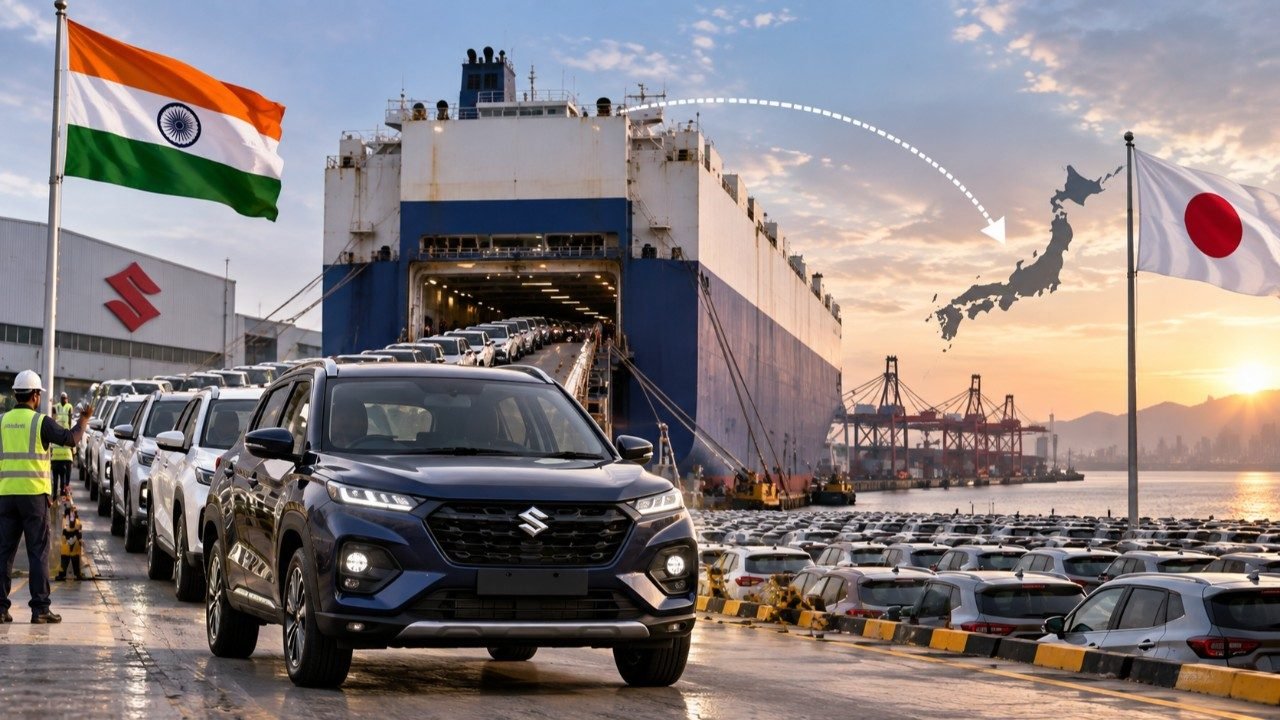
For decades, the flow of automotive expertise between India and Japan has run in one direction: Suzuki's technology and manufacturing know-how coming into India. That relationship has now genuinely reversed at scale. Maruti Suzuki confirmed today that cumulative exports of the Jimny 5-door, Fronx, and e Vitara to Japan have crossed 100,000 units — and nearly every vehicle Suzuki imported into its own home market last fiscal year was built in India.
A Genuinely Rare Kind of Milestone
Here's what makes this figure worth sitting with. Japan is Suzuki's home market — one of the world's most demanding and technically advanced automotive markets, with its own deeply entrenched domestic manufacturing base. For India-built vehicles to not just enter that market but come to dominate Suzuki's own import volumes there is a genuinely unusual achievement, one that few automotive manufacturing relationships anywhere in the world have reached.
Maruti Suzuki-manufactured vehicles accounted for nearly 100% of all vehicles Suzuki imported into Japan during FY2025-26. That's not a meaningful share — it's effectively the entire number.
How the Export Portfolio Built Up
The Fronx was first to make the journey, with exports to Japan beginning in August 2024. The Jimny 5-door followed in December 2024. Then, in September 2025, Maruti Suzuki added its first battery-electric vehicle, the e Vitara, to the export lineup — a genuinely significant addition, since it marked the first time an India-made EV specifically was being shipped to one of the world's most scrutinising automotive markets.
Two of the three models carry particular manufacturing significance: both the Jimny 5-door and e Vitara are built exclusively in India, with no parallel production line anywhere else in Suzuki's global network. That's a meaningful vote of confidence in Maruti Suzuki's manufacturing capability — Suzuki isn't just sourcing overflow production from India, it's making India the sole global source for two of these three models.
What This Means for Maruti's Export Standing
The Japan success has pushed the country into becoming Maruti Suzuki's second-largest export market by volume in FY2025-26, a position it has held onto through the April-August period of the current fiscal year as well. Beyond Maruti Suzuki's own numbers, this export volume has also helped Suzuki Motor Corporation become the No. 1 vehicle importer into Japan during FY2025-26, overtaking every other international automaker selling into that market.
What Maruti Suzuki's Leadership Said
MD and CEO Hisashi Takeuchi framed the milestone as validation that goes beyond simple export numbers: crossing 100,000 units of exports specifically to Japan demonstrates genuine acceptance of India-manufactured vehicles among Japanese customers — a market notoriously particular about build quality and reliability. He also described the achievement as symbolising the broader evolution of the India-Japan manufacturing partnership, from India as a technology recipient toward India as a genuine, trusted production base serving Suzuki's global network, including its most demanding home market.
Why This Fits a Larger Pattern
This announcement lands alongside other recent signals of India's growing role as a genuine global manufacturing hub rather than just a large domestic market. Maruti Suzuki posted record production of 2.34 million vehicles in FY2025-26, with export volumes growing 34% year-on-year to 447,000 units for the year — momentum that this Japan-specific milestone builds directly on top of.
Why This Matters Beyond One Company's Export Chart
For India's broader automotive manufacturing ambitions, a home-market automaker importing nearly all its own domestic supply from its Indian subsidiary is about as strong a manufacturing-quality endorsement as exists in this industry. It's one thing for India-built vehicles to succeed in developing markets or price-sensitive regions. It's a different, considerably higher bar to clear India-built vehicles competing directly in Japan's own backyard — and by this measure, that bar has now been cleared decisively.
Have a tip on India's auto and EV space? Write to us at contact@techyrobber.com