
India's sedan market isn't one story right now — it's two, moving in completely opposite directions. Overall segment sales grew 15.7% year-on-year in August 2026 to 32,913 units, but that growth is almost entirely concentrated at the affordable end, while midsize sedans continue sliding.
The Dzire's Grip Just Gets Tighter
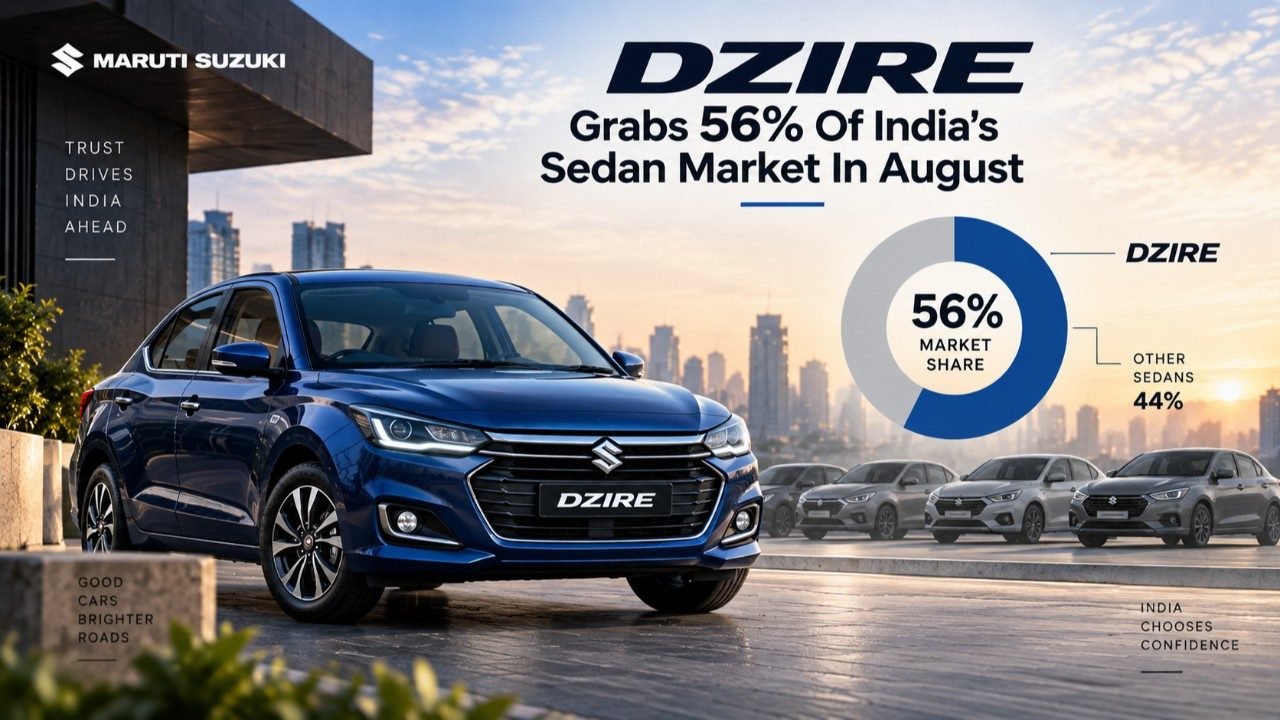
Maruti Suzuki's Dzire led the segment by a genuinely overwhelming margin, selling 18,418 units in August — up 11.6% year-on-year from 16,509 units — and capturing 56% of the entire sedan market on its own. That's more than half of every sedan sold in India last month wearing a single badge, a level of category dominance few models in any segment achieve.
Amaze Posts the Standout Number
Here's the genuinely striking figure buried beneath the Dzire's dominance. Honda Amaze sales more than doubled, jumping 100.3% year-on-year to 3,512 units from 1,753 a year earlier — the sharpest growth of any sedan on the list, holding a 10.7% segment share. That kind of growth rate for an established, non-facelifted nameplate is genuinely rare, and points to real demand momentum rather than a low-base comparison alone explaining the jump.
Hyundai Aura held second place overall with sales up 25.3% year-on-year, giving it a 20.3% segment share — a solid, if less dramatic, growth story sitting comfortably behind the Dzire.
Where the Segment Turns Negative
Move up in price, and the picture flips entirely. Volkswagen Virtus, despite remaining India's top-selling midsize sedan, saw sales decline 22.3% year-on-year to 1,301 units, holding just 4% segment share. Skoda Slavia fell 11% to 897 units. Hyundai Verna dropped the hardest among established players, down 31.4% to 529 units from 771 a year earlier.
Tata Tigor was the lone bright spot among the smaller-volume entries, posting modest 7.1% growth to 862 units — though it remains a minor player overall at 2.6% share.
Why Compact and Midsize Sedans Are Telling Different Stories
Here's the underlying dynamic worth understanding. Compact sedans like the Dzire, Aura, and Amaze sit in the Rs 6.5-10 lakh bracket — genuinely accessible pricing that competes primarily against hatchbacks and entry SUVs, where buyers are often making their first meaningful step up in vehicle size. That price zone has held demand relatively well.
Midsize sedans — the Slavia, Virtus, Verna, and City — sit considerably higher, typically Rs 11-19 lakh, putting them in direct price competition with an increasingly large field of compact and midsize SUVs. Indian buyers have consistently gravitated toward SUV body styles over the past several years even at comparable price points, and August's numbers confirm that pattern hasn't reversed — if anything, it's intensifying for sedans specifically in this bracket.
A Pattern That's Held for Months, Not Just One Month
This isn't a one-off August anomaly. The same divergence showed up clearly in July 2026 data too — compact sedans posting genuine growth while their midsize siblings stayed stuck in decline. That consistency across multiple months suggests this is a structural shift in how Indian buyers are allocating their sedan budgets, not a temporary blip tied to a single month's promotions or inventory timing.
Why This Matters for Manufacturers
For companies still investing in midsize sedans — Volkswagen, Skoda, Hyundai, and Honda all continue selling in this bracket — August's numbers reinforce a genuinely difficult positioning question: compete harder on price and features against a shrinking but still-loyal sedan buyer base, or accept the segment's structural decline and shift further investment toward SUVs where actual demand growth is happening.
Compact sedans, by contrast, look like a genuinely safer bet right now — close enough to hatchback pricing to pull in upgrade buyers, while still offering the boot-separation and perceived status step-up that keeps this specific price bracket resilient even as the broader sedan category struggles above it.
Have a tip on India's auto and EV space? Write to us at contact@techyrobber.com