
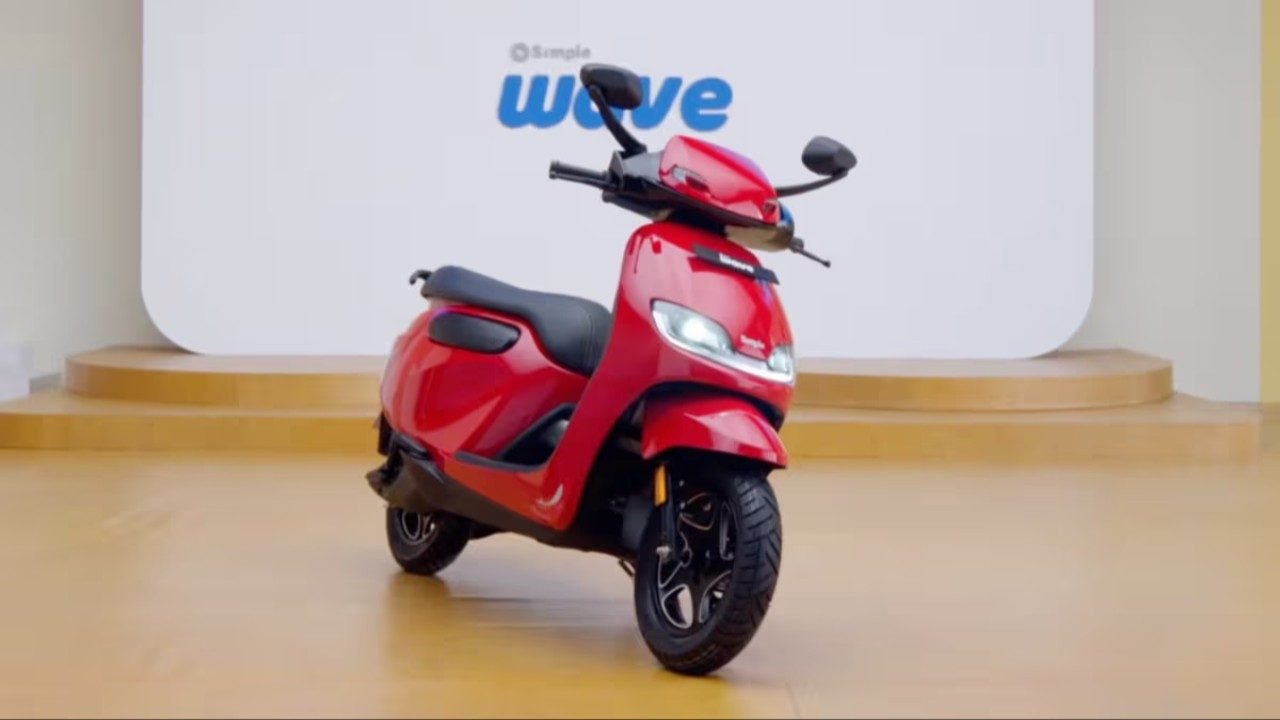
Simple Energy has officially launched the Wave, and after months of teasers under the internal codename "Arrive," the Bengaluru-based startup's first genuinely mass-market scooter is finally real. Prices start at Rs 1.10 lakh, ex-factory, in Bengaluru, with deliveries beginning September 25.
Where the Simple One chased headline numbers — quickest scooter, longest range, largest boot — the Wave takes the opposite approach. Simple Energy is positioning it squarely as a practical family scooter, aimed at buyers in tier-2 and tier-3 cities rather than performance-focused early adopters.
Four Batteries, One Genuinely Wide Spread
Here's what sets the Wave apart from most single-spec launches: it comes in four distinct battery configurations, letting buyers pick range against budget rather than being locked into one option. The base 2.2kWh pack delivers a claimed IDC range of 110km. Step up to 2.7kWh and that climbs to 132km. The 3.7kWh version reaches 171km. At the top sits a 5kWh pack — used in the range-topping Wave+ — claiming 243km, among the widest range spreads offered within a single electric scooter family in India right now.
The lower battery variants use LFP (Lithium Iron Phosphate) chemistry, while the top Wave+ switches to a Nickel Cobalt Aluminium pack instead — a genuinely uncommon choice for this price segment.
The Motor Story Worth Noting
Powering the Wave is a new 6.4kW electric motor that Simple says is built without heavy rare-earth materials — a detail that matters given rare-earth supply chains have become an increasingly sensitive topic globally. The top-spec Wave+ reaches a claimed 90km/h top speed in Sport mode, with 0-40km/h coming up in a claimed 3.3 seconds.
Built Around Everyday Practicality
Simple has clearly designed the Wave around real family use rather than outright performance. Total claimed storage comes in at 70 litres, split between the main underseat compartment and dedicated pill-shaped storage cubbies built into the side panels — small compartments meant for items riders want within easy reach without opening the main storage every time.
Seat height sits at an accessible 775mm, with 175mm of ground clearance. Every battery pack carries an IP67 water and dust resistance rating, and Simple claims 300mm of water-wading capability — genuinely useful specs for India's monsoon riding conditions.
Hardware includes a telescopic front fork, twin rear shock absorbers, a front disc brake, and rear drum brake, riding on alloy wheels — a comfort-tuned setup rather than the sportier monoshock configuration on the existing Simple One.
A Deliberate Strategic Pivot
This launch represents a genuine shift in direction for Simple Energy. The company has, until now, built its identity entirely around performance and headline range with the Simple One and One S. The Wave moves the brand into the much larger family-scooter segment for the first time — a segment where volume, not outright specs, tends to decide long-term success.
That shift comes with real infrastructure investment behind it. Simple currently runs 75 dealerships and is targeting 150-200 touchpoints by the end of this fiscal year, with new service facilities planned to open from November 2026 across Bengaluru, Chennai, Kochi, Goa, Pune, Delhi, Odisha, and Kolkata.
Where It Actually Sits Against Rivals
The Wave enters a genuinely crowded segment, going up against the Bajaj Chetak, TVS iQube, Hero Vida, and the newly launched Ather Konarc — four brands that together account for 76% of all electric two-wheelers sold in India so far this year, according to Autocar India. Range is the Wave's clearest point of differentiation against all four, with its 243km top-end figure comfortably ahead of most direct rivals in this price bracket.
What's Still Unconfirmed
Simple hasn't yet revealed pricing for the higher battery variants beyond the Rs 1.10 lakh entry point, nor has it clarified whether the September 25 delivery date applies uniformly across all four configurations or staggers by variant. A full picture of the Wave's value proposition against its rivals will only be possible once those remaining details land.
For a startup that's spent its first few years chasing performance headlines, the Wave marks Simple Energy's real test: whether it can compete on practicality and value in the segment that actually moves the most volume in India's EV two-wheeler market.
Have a tip on India's auto and EV space? Write to us at contact@techyrobber.com