
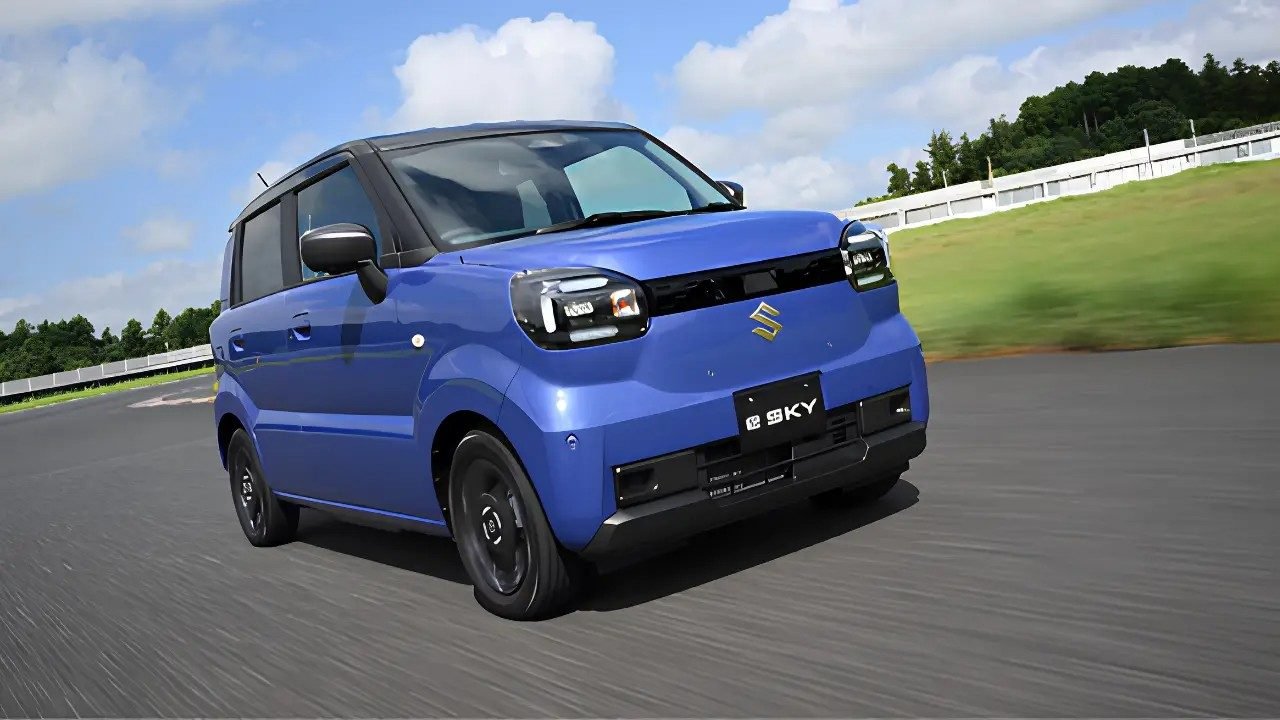
Suzuki has revealed its first electric kei car, and while the e Sky itself is built strictly for Japan's ultra-compact vehicle regulations, the engineering thinking behind it could end up shaping a future Maruti Suzuki EV in India.
The e Sky is set to go on sale in Japan this autumn, between September and November 2026. It measures 3,395mm in length, 1,475mm in width and 1,625mm in height, riding on a 2,460mm wheelbase — dimensions dictated almost entirely by Japan's kei car rules, which cap size and power output in exchange for meaningful tax and registration benefits.
Small Battery, Genuinely Usable Range
Here's the number that stands out. Despite a compact 26kWh lithium iron phosphate battery — modest by current EV standards — Suzuki claims a range of 310km. That's a genuinely practical figure for a car this size, achieved not through a bigger battery but through aggressive weight management.
The e Sky weighs just 1,030kg. For comparison, that's meaningfully lighter than most electric hatchbacks currently on sale globally, many of which carry heavier battery packs to hit similar range figures. Suzuki has been explicit that its approach here isn't to chase the biggest battery or the longest range on a spec sheet, but to prioritise efficiency instead.
What's Actually Inside
A single front-mounted electric motor drives the front wheels, expected to produce around 63-64hp in line with kei car power limits. DC fast-charging tops out at 50kW. Inside, the cabin gets a 10.1-inch touchscreen infotainment system paired with a digital driver's display, along with vehicle-to-load (V2L) capability — letting the car's battery power external devices, a feature increasingly common across newer EVs.
The design stays close to the Vision e Sky concept shown at the 2025 Japan Mobility Show, with a boxy, upright profile aimed at maximising interior space within the compact footprint. Square LED headlights with C-shaped daytime running light segments replace the concept's full-width light bar, giving the production version a more conventional, market-ready appearance.
Why This Actually Matters for India
Here's the part worth paying attention to if you're tracking India's EV market rather than Japan's. Neither Suzuki nor Maruti Suzuki has announced the e Sky for India, and its kei-car dimensions are specifically tailored to Japanese regulations — this exact car isn't heading to Indian showrooms.
But the underlying philosophy is a different story. A lightweight, compact EV with genuinely usable urban range and aggressive pricing is exactly the formula that could work in India's price-sensitive small-car segment — potentially slotting in below larger electric SUVs and competing directly with models like the Tata Tiago EV and MG Comet EV.
Reports suggest the e Sky's underlying platform could ultimately serve as the basis for a new entry-level EV built by Maruti Suzuki in India, with a 2028 timeline being floated. That would mark a meaningfully different approach from Maruti Suzuki's current EV push, which has focused on larger electric SUVs rather than genuinely small, affordable electric cars.
A Different Bet Than the Rest of the Industry
Most automakers have leaned toward bigger batteries as the default answer to range anxiety, even as that pushes vehicle weight and cost upward. Suzuki's approach with the e Sky — small battery, aggressive weight reduction, efficiency-first engineering — runs counter to that trend.
Whether or not the e Sky itself ever reaches India, the engineering direction behind it looks like it could matter more to Suzuki's global entry-level EV strategy than the kei car's actual sales numbers in Japan. For a market like India, where affordability often decides whether an EV purchase happens at all, that's a philosophy worth watching closely.
Have a tip on India's auto and EV space? Write to us at contact@techyrobber.com