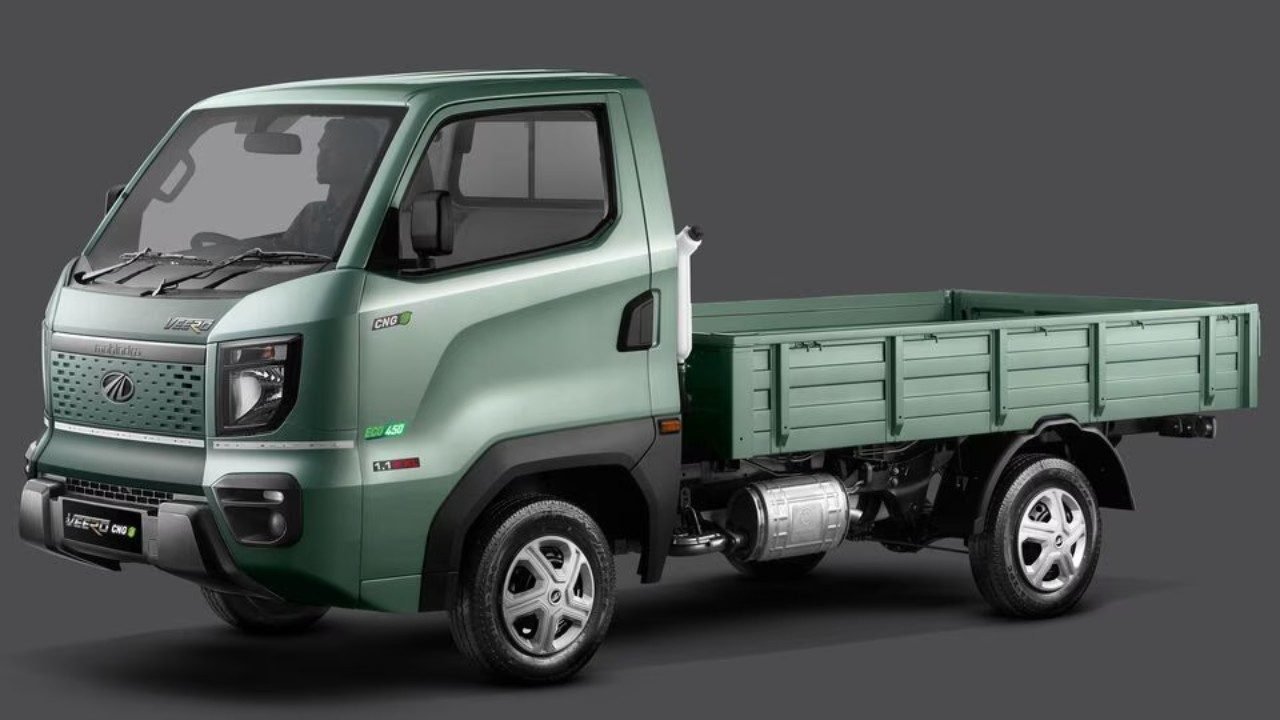
Mahindra has expanded its Veero light commercial vehicle range today, launching a new 1.1-tonne CNG variant alongside a meaningfully upgraded diesel lineup. The new Veero 1.1 XXL CNG starts at Rs 8.25 lakh, ex-showroom, for the V2 trim, rising to Rs 8.55 lakh for V4 — with Pastel Riversand paint carrying a Rs 5,000 premium.
The upgraded Veero Diesel range is available from today, while the new CNG variant reaches customers from September 20.
A CNG Variant Built Specifically for Congested Cities
Here's what makes the 1.1 XXL CNG a genuinely different product rather than just a fuel-type swap. Mahindra already sells a higher-capacity Veero CNG, but this new variant deliberately moves into a lower payload class — 1.1 tonnes, paired with a best-in-class 2,900mm (9.5-foot) cargo deck. That combination lets operators carry higher-volume, lower-weight loads while keeping a genuinely compact footprint, which matters enormously for vehicles that spend their working lives navigating narrow city streets rather than highways.
The 5.1-metre turning radius reinforces that same intent — this is a vehicle engineered specifically for tight urban loading bays and congested delivery routes, not long-haul transport. Power comes from a 1.5-litre naturally aspirated engine producing 48.5kW (66PS) and 98Nm, with Mahindra claiming 21.4km/kg fuel efficiency and a combined petrol-CNG range exceeding 450km.
Who This Vehicle Is Actually Built For
Mahindra has been specific about the target use cases: FMCG distribution, fruit and vegetable transportation, e-commerce deliveries, parcel and courier movement, and general market-load intra-city logistics. That's a genuinely broad spread of small-business and last-mile delivery applications — precisely the segment where India's e-commerce and quick-commerce growth has been driving real demand for compact, efficient commercial vehicles.
The Diesel Update Focuses Entirely on Comfort and Tech
Where the CNG variant expands Mahindra's payload options, the diesel update takes a different approach — leaving the core mechanical package untouched and focusing entirely on the driver's day-to-day experience. The standout addition is a new 26.03cm (10.25-inch) touchscreen supporting Android Auto, Apple CarPlay, and voice commands across multiple languages — a genuinely unusual level of infotainment sophistication for a small commercial vehicle segment that's traditionally treated cabin tech as an afterthought.
Cruise control joins the equipment list too, a meaningful addition for drivers spending long hours behind the wheel on repetitive delivery routes. Other comfort additions include AC with a heater, a reclining driver's seat with adjustable headrest, flat-fold seats with a sleeping provision, a door armrest, and D+2 seating. Power windows and fast-charging ports are now standard across every variant, not reserved for higher trims.
Genuine Safety Additions, Not Just Comfort
Beyond comfort, Mahindra has added a driver airbag and a reverse parking camera as standard equipment — features that remain far from universal in this vehicle category, where safety equipment has historically lagged well behind the passenger vehicle segment. The company is marketing these as "first-in-segment" additions, a claim that holds up reasonably well given how sparse safety equipment typically is on comparable small commercial vehicles.
Pricing Across the Diesel Range
The upgraded Veero Diesel starts at Rs 8.29 lakh for the 1.5 XL SD V2 variant, extending up to Rs 9.45 lakh depending on cargo configuration and trim. The 1.5 XXL SD costs Rs 8.49 lakh in V2, rising to Rs 9.45 lakh in V6. Heavy-duty variants — 1.5 XXL HD and 1.6 XXL HD — are priced at Rs 8.75 lakh in V2 specification, while the 1.5 XXL CBC (cab-and-chassis) version runs Rs 8.35 lakh in V2 and Rs 8.68 lakh in V4.
Why the Platform Underneath Matters
The Veero was originally launched in September 2024, built on Mahindra's Urban Prosper Platform (UPP) — described as India's first ground-up, multi-energy modular commercial vehicle architecture. That platform design is exactly what makes today's expansion possible without a lengthy re-engineering cycle: a single underlying architecture that can support diesel, CNG, and future powertrain variants without requiring separate development from scratch for each one.
Why the Timing Makes Sense
Launching this expanded lineup right as India heads into its festive season is a deliberate commercial calculation, not coincidence. Small business owners and delivery operators typically ramp up fleet purchases ahead of the year's highest-demand shopping period, and a broader Veero lineup — spanning payload capacities, fuel types, and price points — gives Mahindra more configurations to match specific operator needs exactly when that buying decision is happening.
For operators weighing running costs against upfront price, the choice now genuinely comes down to use case: the CNG variant for lower running costs on shorter, high-frequency urban routes, or the upgraded diesel for drivers who value the added comfort and safety equipment on longer working days.
Have a tip on India's auto and EV space? Write to us at contact@techyrobber.com