
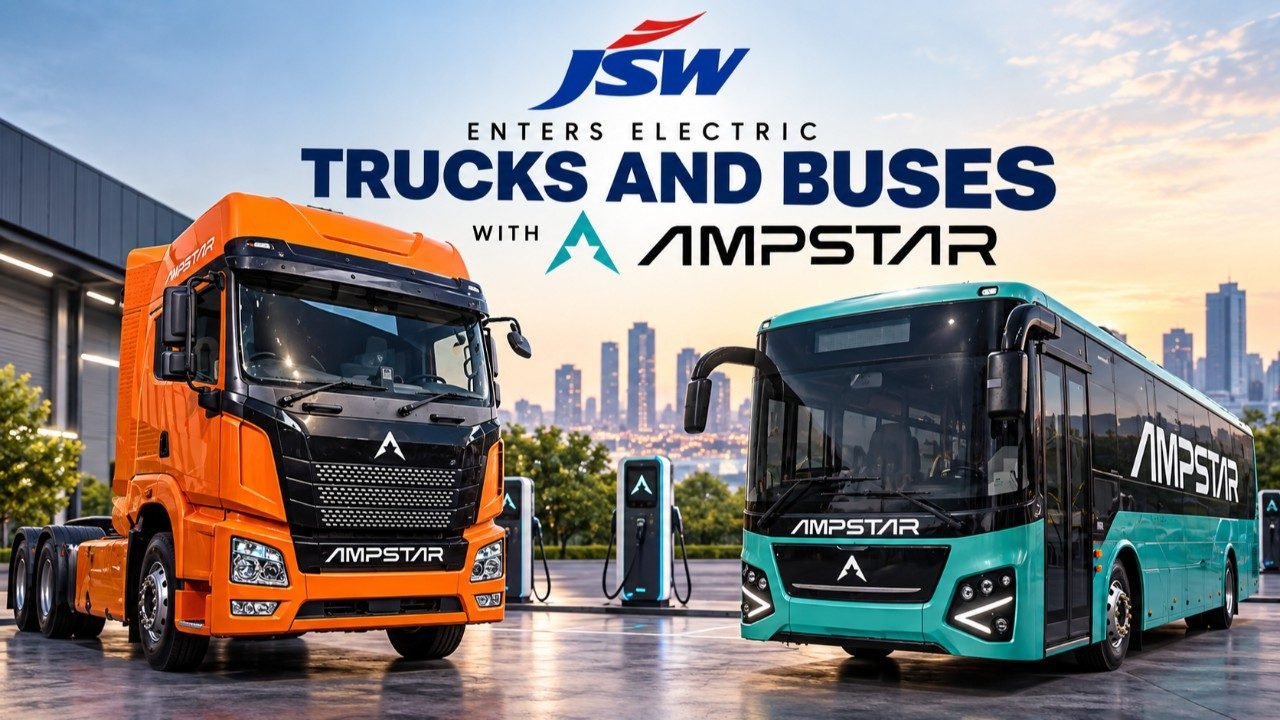
JSW Group's automotive ambitions just extended into an entirely new category. JSW Greentech Limited, the conglomerate's commercial electric vehicle arm, officially launched its brand AMPSTAR — marking JSW's formal entry into designing, manufacturing, and selling electric buses and trucks in India, backed by a Rs 2,500 crore investment.
A Second Automotive Business, Running Parallel To The First
Here's what makes this launch significant beyond its own scope. We've covered JSW's passenger vehicle ambitions extensively — the JSW Combat SUV expected this festive season, the company's dealer-network buildout, and its non-binding MoU with Volkswagen Group covering a proposed passenger vehicle alliance. AMPSTAR represents JSW's genuinely separate second automotive business, running in parallel to that passenger vehicle push rather than being folded into it. JSW already has a presence in passenger vehicles through its MG Motor India partnership, is building its own JSW Motors brand, and is simultaneously entering commercial electric vehicles through this new venture — a genuinely broad simultaneous automotive expansion for a single conglomerate.
What AMPSTAR Is Actually Building First
The immediate focus is heavy commercial vehicles, starting with a 55-tonne electric tractor-trailer. The broader planned range extends to tippers, fixed-body dumpers, and buses spanning 7 metres to 18 metres, covering staff transportation, city transit, intercity travel, and school transport applications. Electric trucks will be offered with both fixed and swappable battery layouts, with battery capacity and configuration selectable based on individual customer operational requirements — power configurations will range from 150kW to 500kW.
A Genuine Full-Stack Approach, Not Just Vehicles
Here's the strategic detail that separates AMPSTAR from a straightforward vehicle manufacturer. The brand has been deliberately structured to extend beyond the vehicles themselves, encompassing charging infrastructure, operating solutions, financing, and after-sales support. Customers get multiple acquisition models to choose from — outright purchase, leasing, and Battery-as-a-Service — the same flexible ownership structure we've tracked across passenger EV launches from Mahindra, MG, and Citroen this year, now extended into the commercial vehicle space.
That's a meaningful strategic choice. Electric commercial vehicle adoption has historically been held back by concerns beyond the vehicle itself — charging access, financing structures, and after-sales reliability. By bundling all of these into one offering from the start, JSW is addressing the barriers that have slowed EV adoption in this segment, not just building another electric truck.
Built On In-House Engineering, For Indian Conditions Specifically
JSW Greentech has developed the software, algorithms, and underlying electric drivetrain architecture entirely in-house — a genuine engineering investment rather than licensing someone else's platform. The vehicles feature a dual cooling battery system and a high-strength monocoque chassis, specifically engineered for Indian road and climate conditions rather than adapted from a global platform designed for different operating environments.
A Manufacturing Facility Built At Genuine Scale
AMPSTAR vehicles will be produced at a new 90-acre greenfield facility at AURIC, Chhatrapati Sambhajinagar, Maharashtra, with initial annual capacity of 15,000 electric buses and trucks. The facility includes what's described as India's first pre-treatment and electro-deposition process specifically for bus manufacturing, alongside an automated truck-cabin production line and an integrated battery ecosystem — genuinely comprehensive vertical integration rather than final assembly of externally sourced components.
Why JSW's Existing Business Gives It A Genuine Advantage
Here's a detail worth understanding about JSW's starting position in this market. The group's existing steel, cement, and port operations already run roughly 17,000 trucks internally — giving JSW Greentech immediate access to a large, captive commercial vehicle ecosystem for its own fleet needs, well before it needs to win external customers. The initial go-to-market strategy leans directly into this: closed-loop operations between factories, mines, ports, and other fixed locations, where charging or battery-swapping infrastructure can be arranged at known, predictable points rather than requiring broad public charging network coverage from day one.
What Sajjan Jindal Said About The Strategic Motivation
JSW Group Chairman Sajjan Jindal framed the launch in terms extending well beyond commercial logic: "When we decided to enter electric commercial mobility, I saw it as an act of nation-building — moving India's people and goods on power generated within India, rather than fuel sourced from outside. We cannot control global oil prices. But we can control how much we depend on them."
The Numbers Behind JSW's Ambition
Parth Jindal, MD of JSW Cement and JSW Paints, outlined targets that are genuinely aggressive: 1 lakh electric trucks and buses sold annually by 2030, positioning AMPSTAR among India's top three commercial vehicle manufacturers, and roughly Rs 12,000 crore in revenue within five to seven years. For context on how ambitious that market-position target actually is, Tata Motors currently dominates India's electric commercial vehicle market with a 30.11% retail share as of August, ahead of Euler Motors at 18.06% and Sany Heavy Industry India at 12.87%.
What Happens Next
AMPSTAR's first electric buses and trucks are expected on Indian roads within the next 30 days, starting with the business-to-business model targeting heavy commercial applications across ports, cement, and steel sectors — industries JSW Group already operates within directly, giving the new brand genuine internal demand to build early volume around before expanding into the broader external market.
Have a tip on India's auto and EV space? Write to us at contact@techyrobber.com