<!-- === SEO TAGS === Title Tag: Made-in-India Toyota Starlet Gets a Shocking 0-Star Global NCAP Rating – Should Glanza and Baleno Owners Worry? Meta Description: The India-made Toyota Starlet scored 0 stars in Global NCAP crash tests with an unstable bodyshell and poor protection. It's essentially the same car as the Glanza and Baleno. Here's what happened and what it means for Indian buyers. Focus Keyword: Toyota Starlet 0 star Global NCAP rating Secondary Keywords: Toyota Starlet crash test, Starlet GNCAP 0 star, Toyota Glanza safety, Maruti Baleno NCAP rating, Starlet vs Baleno safety, Global NCAP vs Bharat NCAP, made in India car safety Tags: Toyota Starlet, Global NCAP, 0 Star Rating, Crash Test, Toyota Glanza, Maruti Baleno, Car Safety India, Bharat NCAP, Unstable Bodyshell, Airbags, SaferCarsForAfrica Category: Cars Author: TechyRobber Team -->
Made-in-India Toyota Starlet Gets a Shocking 0-Star Global NCAP Rating – Should Glanza and Baleno Owners Worry?
Zero. Not one star. Not two. Zero stars out of five for adult occupant protection.
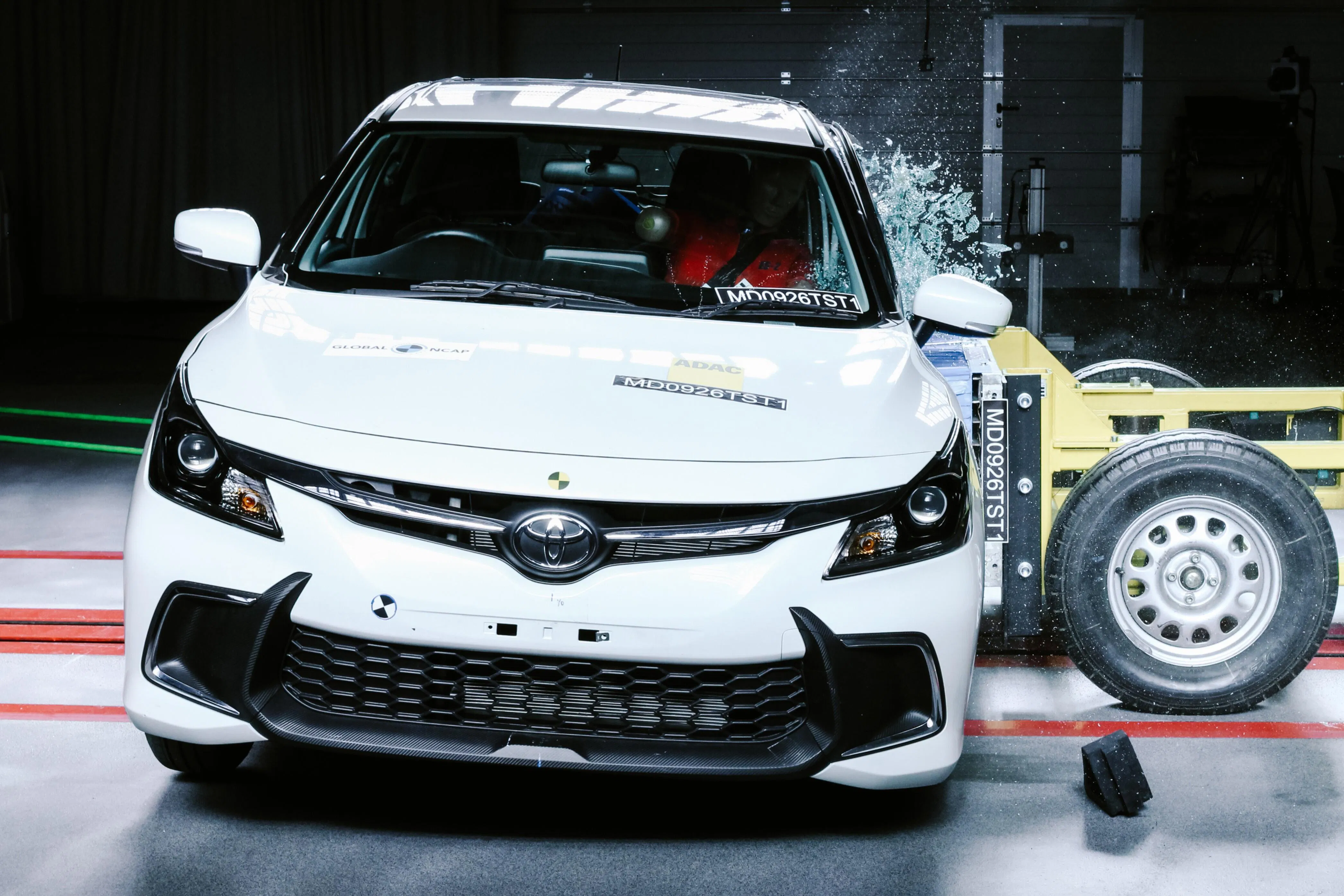
That's the result the Toyota Starlet – manufactured in India and exported to South Africa – received in the latest round of Global NCAP crash tests. And if that name doesn't ring a bell, here's why you should care: the Toyota Starlet is essentially the same car as the Toyota Glanza sold in India, which itself is a rebadged Maruti Suzuki Baleno.
The same platform. The same factory (Maruti's Gujarat plant). The same fundamental body structure. And yet, the Maruti Baleno scored 4 stars in Bharat NCAP tests – while its near-identical twin from Toyota just scored zero in Global NCAP.
How is that even possible? And should the millions of Baleno and Glanza owners in India be concerned?
What Exactly Happened in the Crash Test?
Global NCAP tested the South African-specification Toyota Starlet as part of its #SaferCarsForAfrica campaign. The results were damning.
Adult Occupant Protection: 0 Stars
| Test Result | |
| Overall AOP Score | 0 out of 34 points |
| Bodyshell Integrity | Unstable |
| Head Protection (Driver) | Adequate |
| Chest Protection (Driver) | Adequate |
| Head Protection (Co-Driver) | Good |
| Neck Protection | Good (both) |
| Knee Protection | Marginal (both) |
| Driver's Feet | Marginal |
The headline number – 0 out of 34 – is brutal. But the detail that matters most is the "unstable" bodyshell rating. This means the car's structural shell deformed beyond acceptable limits during the crash, compromising the survival space around the occupants. An unstable bodyshell is the most fundamental safety failure a car can have – no amount of airbags can compensate if the structure around you is collapsing.
Child Occupant Protection: 3 Stars
| Test Result | |
| Overall COP Score | 29.33 out of 49 |
| 18-Month Child (Frontal) | 6.71/8 |
| 3-Year-Old Child (Frontal) | 2.81/8 |
| 18-Month Child (Side) | 4/4 |
| 3-Year-Old Child (Side) | 0/4 |
The 3-year-old child dummy scored zero in the side impact test – Global NCAP noted that the child's head was exposed during the test, meaning the child restraint system failed to contain the dummy properly.
What Safety Equipment Did the Tested Car Have?
This is a critical detail. The Starlet tested by Global NCAP was equipped with:
- 2 airbags (driver and front passenger only)
- Electronic Stability Control (ESC)
- ISOFIX child seat anchor points
- Seatbelt reminders for all seats
- Pretensioners for driver and co-driver
Notably absent: side airbags, curtain airbags, and side head protection. The Indian-spec Toyota Glanza comes with 6 airbags as standard – a significant difference that would likely change the test outcome.
The Baleno Contradiction – 4 Stars vs 0 Stars
This is where the story gets genuinely confusing for consumers.
The Maruti Suzuki Baleno – which shares its platform, body structure, and Gujarat manufacturing facility with the Starlet – scored 4 stars in Bharat NCAP crash tests. That 4-star rating was awarded to both the 2-airbag and 6-airbag versions of the Baleno.
So how does a car score 4 stars in one crash test and 0 stars in another that's supposed to be testing the same thing?
Different Testing Protocols
Bharat NCAP and Global NCAP, while similar in their overall approach, have different testing protocols, speed thresholds, and scoring methodologies. The specific impact speeds, barrier types, and measurement criteria vary between the two organizations. These differences can produce significantly different outcomes for the same vehicle.
Global NCAP CEO Richard Woods called the result "a shocking zero-star result from Toyota," highlighting the unstable bodyshell and poor head and chest protection as causes for "serious concern."
Different Specifications
The tested Starlet had only 2 airbags. The Indian Baleno and Glanza get 6 airbags as standard. Side and curtain airbags make a dramatic difference in side impact tests – the Starlet's "Poor" ratings for head and chest protection in the side impact test were a direct consequence of having no side airbags.
The Bodyshell Question
Here's the uncomfortable part: airbags aside, the bodyshell instability noted by Global NCAP is about the car's fundamental structure, not its airbag count. If the Starlet's bodyshell is unstable, and the Baleno/Glanza share the same body structure manufactured at the same plant, that raises questions that go beyond airbag specifications.
It's important to note that Bharat NCAP rated the Baleno's structure more favourably. Whether this reflects genuine structural differences between the South African and Indian specifications, or differences in how the two testing organisations evaluate bodyshell integrity, remains unclear. Neither Toyota India nor Maruti Suzuki has issued a detailed technical response addressing this specific discrepancy.
What Toyota Has Done in Response
To their credit, Toyota didn't ignore the results. Global NCAP confirmed that during the transport and testing process, Toyota notified them that the Starlet was being updated in the South African market. The updated version now includes:
- Side head airbags (added as standard)
- Side body airbags (added as standard)
- Additional safety features
Global NCAP has already purchased updated Starlet units anonymously and plans to re-test them. The organization says it wants to give African consumers the opportunity to compare the safety performance of both versions.
This is a positive response, but it also raises a question: if Toyota knew the 2-airbag Starlet was vulnerable – and they clearly did, given how quickly the update was rolled out – why was it sold in that configuration in the first place?
Should Indian Glanza and Baleno Owners Be Worried?
This is the question on everyone's mind. And the nuanced answer is: concerned, but not panicked.
Reasons not to panic: The Indian-spec Glanza and Baleno come with 6 airbags as standard, including side and curtain airbags. The tested Starlet had only 2. The 4 additional airbags make a meaningful difference in occupant protection, especially in side impacts – which is where the Starlet performed worst.
The Baleno has been tested by Bharat NCAP and scored 4 stars. While BNCAP and GNCAP use different protocols, 4 stars is a respectable result that indicates reasonable structural integrity and occupant protection.
Reasons for concern: The bodyshell instability noted by Global NCAP is not an airbag issue – it's a structural issue. If the fundamental body structure is the same between the Starlet and the Baleno/Glanza, the instability concern doesn't disappear just because more airbags are bolted on. Airbags reduce injury severity; they don't prevent the cabin from deforming.
The discrepancy between BNCAP and GNCAP results on what is essentially the same car manufactured at the same facility deserves a clear technical explanation from both Maruti Suzuki and Toyota. Until that explanation comes, a degree of uncertainty remains.
The Bigger Safety Picture in India
This result arrives at an interesting moment for automotive safety in India. Bharat NCAP has been operational for over a year now, and Indian manufacturers have been actively chasing high ratings – Tata, Mahindra, Maruti, and Hyundai have all submitted multiple models for testing, with many achieving 4 and 5-star results.
But the Starlet's Global NCAP score serves as a reminder that safety ratings are not universal truths. They are the output of specific test protocols conducted under specific conditions. A 4-star BNCAP rating and a 0-star GNCAP rating for closely related vehicles highlights the importance of understanding what each rating actually measures – and the limitations of using any single rating as a definitive safety benchmark.
For Indian buyers, the practical takeaway is straightforward: always opt for the variant with the maximum number of airbags. The difference between 2 airbags and 6 airbags is not a luxury – the Starlet's GNCAP result proves that dramatically. Side and curtain airbags can be the difference between walking away from a crash and not.
What Happens Next?
Global NCAP will re-test the updated Toyota Starlet with additional airbags. That result will be telling – if the updated version scores significantly higher, it confirms that the original score was primarily an airbag issue. If it still scores poorly, the bodyshell integrity concern becomes much more serious.
We've reached out to Toyota India for comment on the Starlet's GNCAP result and its implications for the Indian-spec Glanza. Autocar India reports they have also contacted Toyota India but have not yet received a response.
Until the re-test results are published, Baleno and Glanza owners with 6-airbag variants can take reasonable comfort in their additional passive safety equipment. But the conversation about bodyshell integrity – and the gap between different crash test protocols – is one that the Indian automotive industry needs to have openly.
For the latest car safety news, crash test results, and honest automotive coverage – keep visiting TechyRobber.com. If you found this breakdown useful, share it with every Baleno and Glanza owner you know.