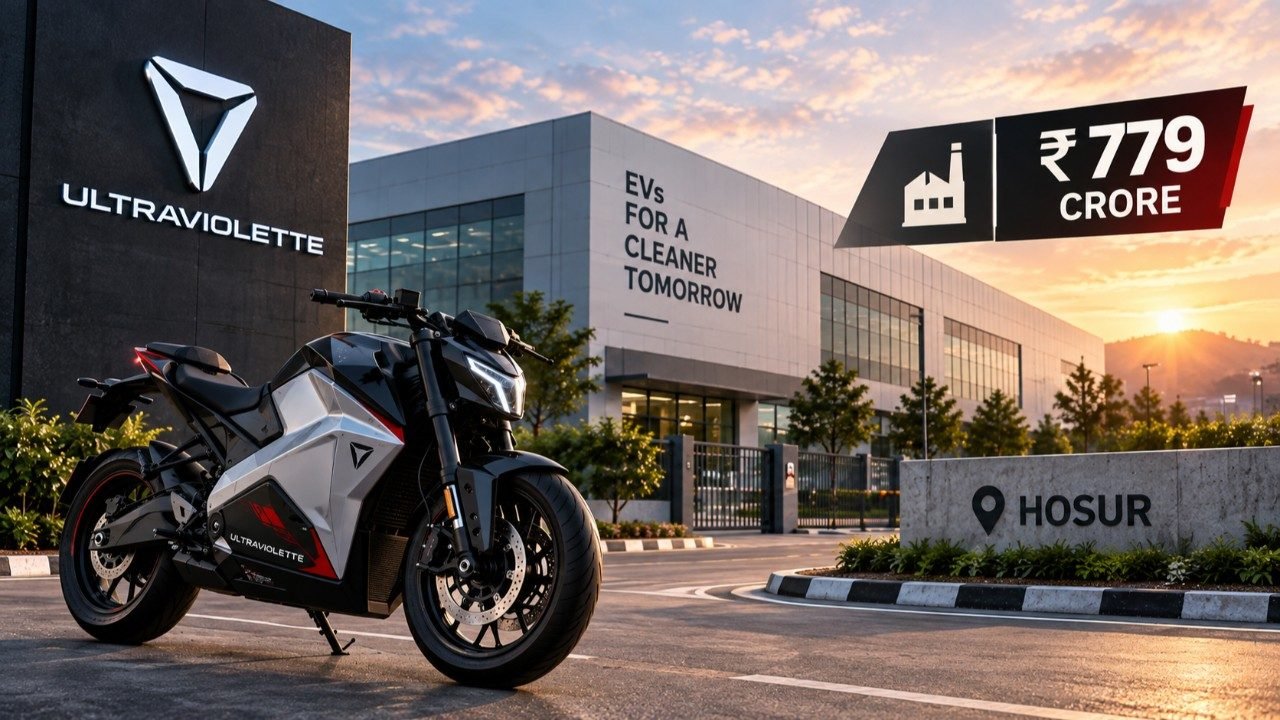
Ultraviolette Automotive has announced plans to invest Rs 779 crore (roughly $82 million) over the next five years in a new manufacturing facility in Hosur, Tamil Nadu, marking the Bengaluru-based EV maker's biggest capacity expansion to date. The plant is expected to initially produce 250,000 electric two-wheelers annually, with room to scale up to 500,000 units as demand grows.
Why Existing Capacity Isn't Enough Anymore
Here's the core problem this investment solves. Ultraviolette's current manufacturing facility near Bengaluru tops out at 50,000 units a year — a ceiling that co-founder and CEO Narayan Subramaniam says the company has already outgrown. "The demand we have for our products, including what is coming up next with the Tesseract and the Shockwave, is far more than the current facility can cater to," he said.
That's a genuinely different problem than most EV startups face. Rather than struggling to generate demand, Ultraviolette's constraint has become physical production capacity — a considerably better position to be in, but one that still requires serious capital to actually solve.
A Deliberate Shift From Premium to Mass-Market
Ultraviolette has built its reputation on premium electric motorcycles — the F77 and X-47 — competing at price points well above what most Indian two-wheeler buyers typically spend. The Hosur facility exists specifically to support a strategic pivot away from that premium-only positioning.
Two upcoming products anchor this shift. The Tesseract, an electric scooter, is priced under Rs 1.5 lakh and expected to enter the market in Q1 2027, with Subramaniam projecting it could scale to around 10,000 units a month relatively quickly. The Shockwave, a more affordable motorcycle, is priced below Rs 2 lakh. Both represent a genuinely different customer than Ultraviolette's existing premium buyer base — this is a company deliberately walking down-market to chase volume, not just protecting its premium niche.
The Numbers Behind Ultraviolette's Confidence
Ultraviolette isn't a small player pretending at scale. The company sold more than 3,000 electric motorcycles globally in the first half of 2026 — comfortably ahead of Zero Motorcycles' roughly 1,756 units and Harley-Davidson's LiveWire at around 300 units over the same period, according to figures the company shared. That's a genuinely strong competitive position against established international electric motorcycle brands, not just domestic rivals.
Exports to Europe and Latin America currently make up about 15% of Ultraviolette's sales, with Subramaniam projecting that share could climb to 25% within five years — a meaningful international ambition for a company that's still scaling its core domestic manufacturing base.
Why the Timing Lines Up With Broader Market Signals
This announcement doesn't exist in isolation. Government data shows India's electric two-wheeler sales crossed 1.03 million units in the first eight months of 2026, with EVs crossing 10% of overall two-wheeler sales for the first time in August — a threshold we've covered in detail through recent FADA data. McKinsey projects electric two-wheeler adoption could reach 40-45% of the segment by FY2030.
There's also a specific demand driver worth noting: rising concerns among owners of older petrol vehicles about compatibility with E20 ethanol-blended fuel appear to be nudging some buyers toward electric alternatives — a factor adding incremental demand on top of the broader structural shift toward EVs.
The Backers Behind the Bet
Ultraviolette counts Qualcomm and TVS Motor among its investors — backing that gives the company both technology credibility and an established two-wheeler manufacturer's strategic input, a genuinely useful combination for a startup attempting to scale manufacturing capacity this aggressively.
Why This Matters Beyond One Company's Factory
A Rs 779 crore investment from an EV startup, timed specifically around entering sub-Rs 2 lakh price points, signals something bigger than one company's expansion plan. It's a bet that India's mass-market electric two-wheeler segment — the volume end of the market currently dominated by TVS, Bajaj, Ather, and Ola — has room for a new entrant built on a premium-performance brand identity, now pivoting downward to chase the customers who actually move the biggest numbers.
Whether Ultraviolette can execute that pivot as smoothly as its capacity expansion plans suggest will become clearer once the Tesseract scooter actually reaches showrooms in early 2027, and once real sales data replaces the company's own volume projections.
Have a tip on India's auto and EV space? Write to us at contact@techyrobber.com