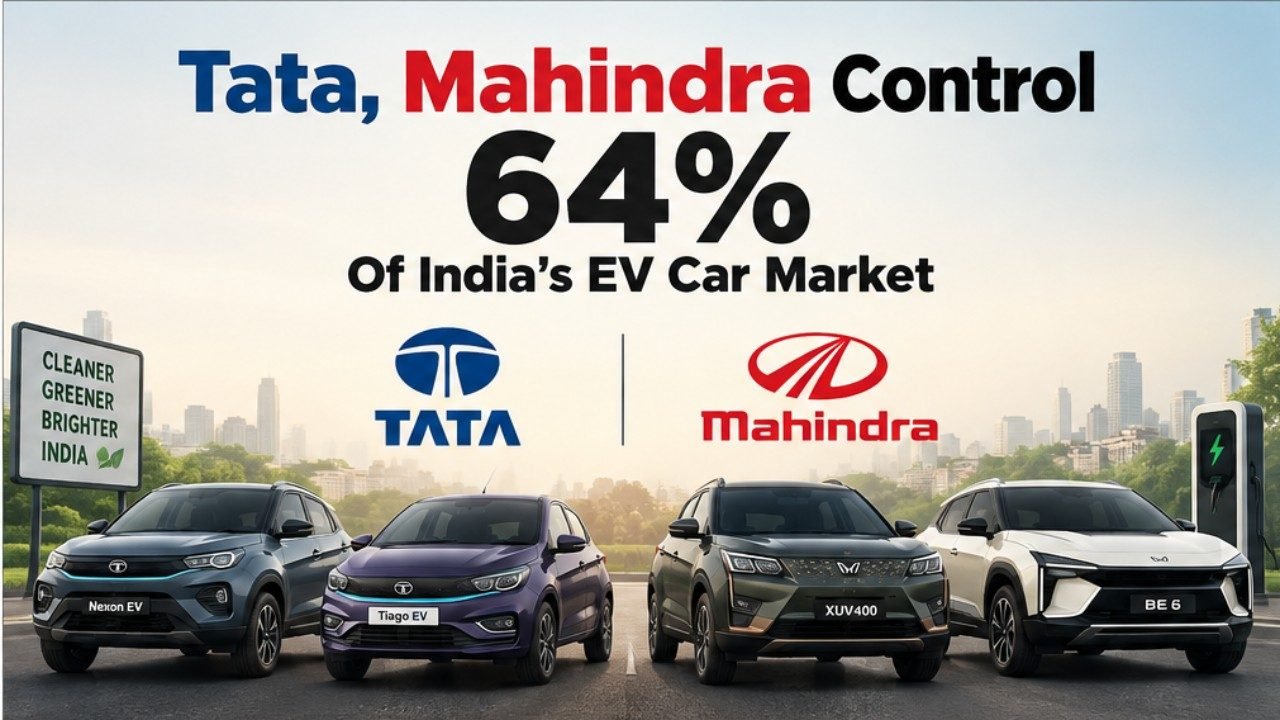
India's electric car market grew sharply in August 2026, but the growth wasn't spread evenly. Two manufacturers — Tata Motors and Mahindra — together accounted for nearly 64% of every electric car registered in the country during the month, according to Vahan registration data.
Total electric car registrations reached 30,051 units in August, up 53.1% year-on-year from 19,629 units a year earlier, even as volumes fell 11.1% from July's 33,791 units — a sequential dip broadly in line with the seasonal monsoon slowdown affecting the wider auto retail market this month.
Tata's Grip Just Got Tighter, Not Looser
Tata Motors registered 13,158 electric cars in August, a 63.17% jump from 8,064 units a year earlier. That gave the company a 42.87% market share — meaning more than four out of every ten electric cars sold in India last month wore a Tata badge. Notably, Tata's share actually expanded compared to August 2025, rising from 41.1% to 43.8% (figures vary slightly depending on the data cut used by different analysts, landing between 42.8% and 43.8% across sources) — a genuinely rare outcome for a market leader facing intensifying competition from multiple directions.
Tata's advantage comes from breadth rather than a single hero product. The company covers electric price brackets from entry-level hatchbacks through mid-size family SUVs, giving it an electric option at nearly every point buyers actually shop at — a strategy that's proven considerably harder for rivals to replicate quickly.
Mahindra Solidifies Second, Even With a Rough Month-on-Month Dip
Mahindra held second place with 6,464 units, up a strong 56.17% year-on-year from 4,139 units. That's a 21.06% market share. The month-on-month picture was less flattering — registrations fell as much as 16.5-20% from July, depending on the data source — but the year-on-year trajectory remains firmly upward, powered by Mahindra's growing Electric Origin SUV lineup: the BE 6, XEV 9e, and XEV 9S.
Together, Tata and Mahindra's combined 63.9% share means the remaining seven-plus manufacturers in India's electric car market are splitting roughly a third of total volume between them — a genuinely concentrated market for a segment that's supposed to be in its early, more fragmented growth phase.
MG's Decline Stands Out Against an Otherwise Growing Market
JSW MG Motor held third place with registrations between 4,568 and 4,622 units depending on the source, but unlike every other major player, MG's numbers actually fell — down roughly 17.8% year-on-year and as much as 22% from July. That's a notable divergence in a month where the overall market grew sharply; MG's decline came specifically before the Hector Tomahawk's EV and PHEV variants had meaningfully ramped up deliveries, based on our earlier coverage of that launch.
VinFast's Quiet Climb Past Maruti
Here's a genuinely interesting subplot buried in the rankings. VinFast registered 2,199 units, up 48.38% month-on-month, moving the Vietnamese automaker past Maruti Suzuki into fourth place. That climb comes right after VinFast publicly denied reports — which we covered separately — that it had paused its broader India expansion plans, even as deeper manufacturing localisation on three specific models remains on hold. The sales growth suggests that pause hasn't dented actual showroom demand for the VF6 and VF7 currently on sale.
Maruti Suzuki, by contrast, saw EV registrations decline 11.75% month-on-month to 1,412 units, holding a modest 4.6% share. Hyundai registered 803 units, up a strong 41.87% month-on-month — a smaller base, but a meaningful acceleration ahead of its planned entry into the compact EV SUV segment later this year.
Why Market Concentration Like This Matters
A market where two players control roughly two-thirds of volume isn't necessarily unhealthy — Maruti Suzuki has held a comparably dominant position in India's overall combustion passenger vehicle market for years. But the comparison has an important limit: Maruti's dominance sits in a large, mature market; Tata and Mahindra's EV dominance sits in a market that's still rapidly changing shape, where a single new model launch or pricing shift from a rival can move share percentages considerably faster than in the combustion segment.
For competitors sitting below the top two, August's numbers are a clear signal: closing the gap on Tata and Mahindra will require more than incremental model additions — it needs the kind of broad, multi-price-point coverage that's currently giving the two leaders their structural advantage.
Have a tip on India's auto and EV space? Write to us at contact@techyrobber.com