
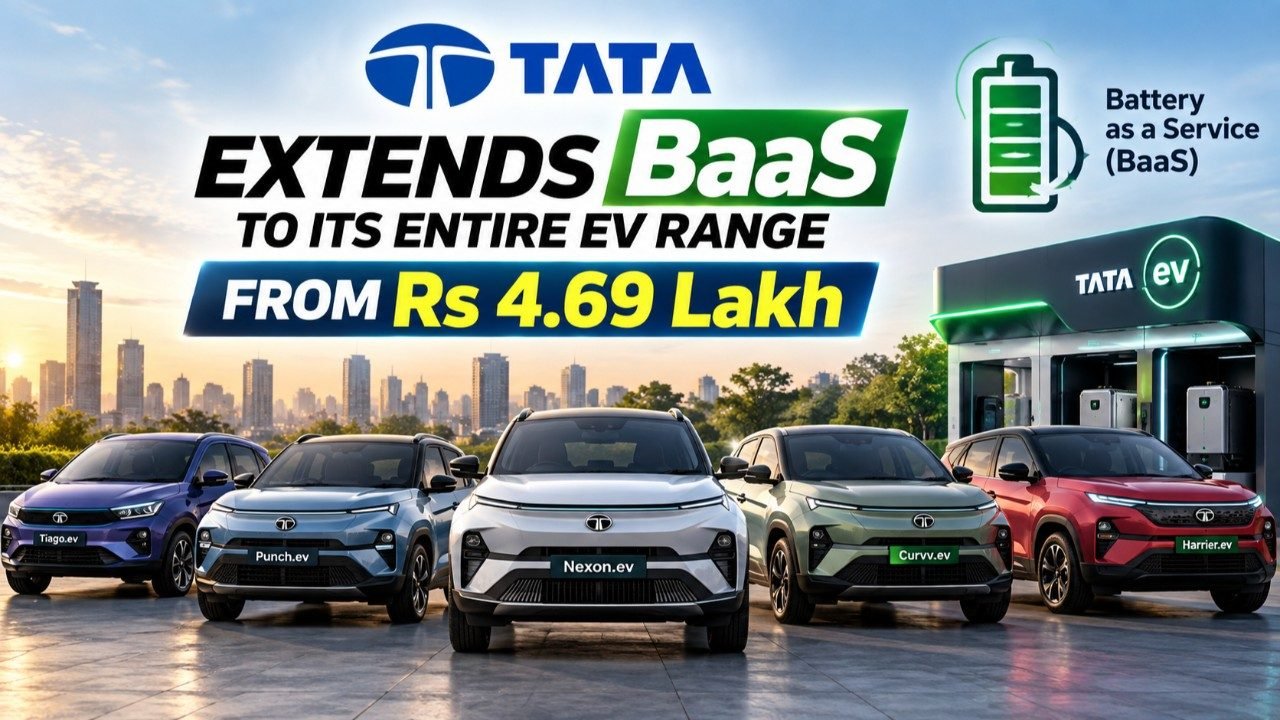
Tata Motors has extended its Battery-as-a-Service option across its complete passenger EV lineup, a scheme that previously applied only to entry-level models. Buyers can now choose BaaS on the Nexon EV, Curvv EV, Sierra EV, and the flagship Harrier EV, with the entry price under this structure starting at Rs 4.69 lakh.
How The Mechanism Actually Works
Here's what separates BaaS from a standard purchase. Tata physically separates the vehicle's chassis from its battery pack at the point of sale. Instead of paying the full, traditional sticker price upfront, buyers finance the car and the battery as two independent components. That structure moves the single most expensive part of any EV — the battery — out of the upfront cost and into a recurring, subscription-style monthly payment instead.
Why Extending This To The Harrier EV Is The Real Story
BaaS starting on the Tiago EV and Punch EV made intuitive sense — those are already Tata's most price-sensitive models, aimed at buyers for whom every lakh of upfront cost matters. Extending the same structure to the Harrier EV, Tata's flagship electric SUV, is a genuinely different decision. It signals Tata sees BaaS not as a budget-segment workaround, but as a financing tool worth offering across its entire range, including buyers who could likely afford the full upfront price anyway.
Why This Fits A Broader Pattern We've Tracked
This mirrors a financing structure we've already covered from Mahindra, MG, and Citroen this year — each expanding BaaS or similar battery-separated pricing across more of their own lineups rather than confining it to a single entry-level model. Tata following the same path across its entire EV range suggests the industry has converged on BaaS as a genuine, durable pricing tool rather than a temporary promotional gimmick.
The Trade-Off Buyers Should Actually Weigh
A lower upfront number is the headline, but it isn't automatically the cheaper option over years of ownership. The monthly battery payment continues for as long as the buyer keeps the arrangement, and depending on how many kilometres someone drives and how many years they keep the car, an outright purchase can end up costing less in total than BaaS over the vehicle's full life. The right choice depends entirely on individual usage patterns and how much upfront cash a buyer wants to avoid committing at purchase.
What This Signals For India's EV Pricing Going Forward
With Tata now offering BaaS across its complete range, rather than treating it as an entry-tier feature, the option has effectively become a standard purchase path across India's EV market rather than an exception. For buyers who've been priced out of specific models purely by the battery's upfront cost, that shift genuinely widens what's realistically within reach — provided they're comfortable with the ongoing monthly commitment that comes with it.
Have a tip on India's auto and EV space? Write to us at contact@techyrobber.com