
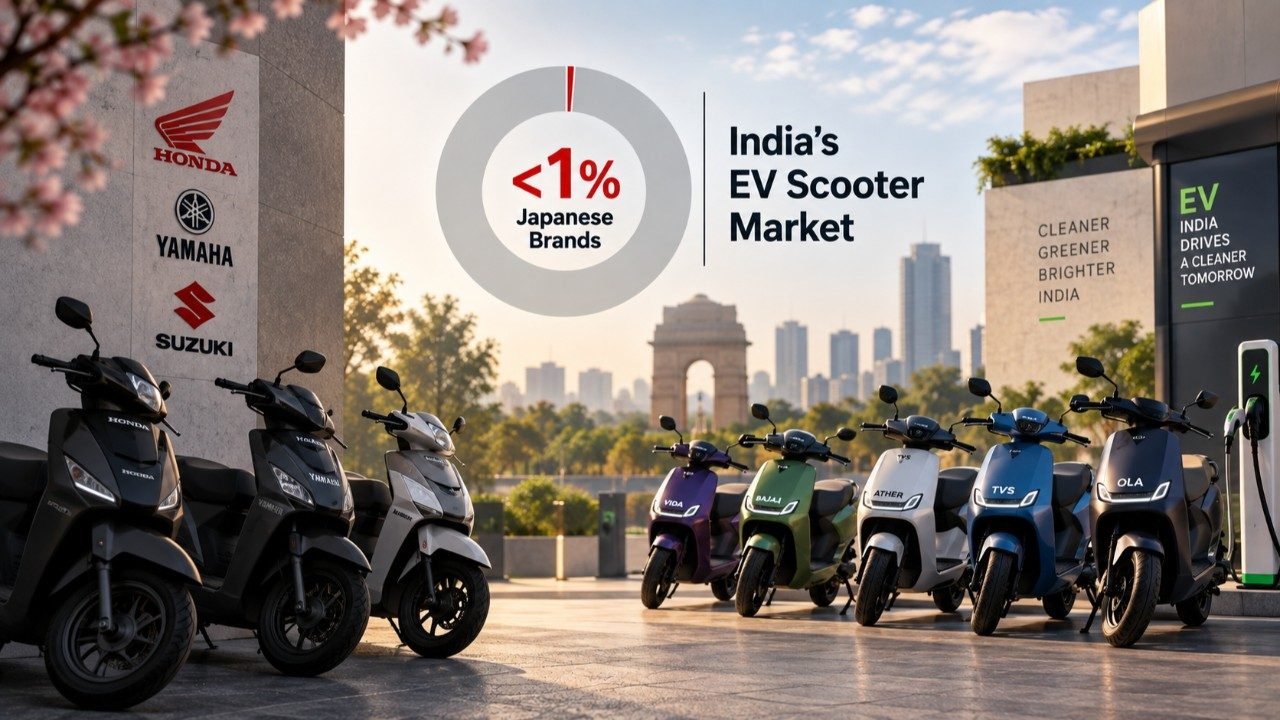
India's electric two-wheeler market has produced a genuinely lopsided scoreboard, and the gap keeps widening rather than closing. Electric two-wheelers accounted for nearly 11% of India's total two-wheeler registrations in August 2026, with roughly 1.83 lakh units sold during the month. Honda, Suzuki, and Yamaha combined accounted for less than 1% of that entire electric segment.
That's not a rounding error or a temporary lag while the Japanese majors ramp up production. It's a structural gap that's held steady across multiple reporting periods this year, and the reasons behind it go well beyond simple timing.
Where the Actual Volume Is Coming From
TVS Motor alone registered 48,873 electric two-wheelers in August, good for roughly 27% market share on its own. Bajaj followed with 41,019 units, Ather registered 28,708, and Hero Vida added another 18,978 — four homegrown players collectively accounting for the overwhelming majority of a fast-growing segment.
Zoom out to the first eight months of 2026, and the picture gets starker still. TVS, Bajaj, Ather, and Vida together crossed the one-million-unit mark in combined electric two-wheeler sales, representing roughly 76% of India's total EV two-wheeler volume for the period. TVS alone sold 3,56,579 units between January and August — a 26% market share held by a single company.
Why the Japanese Majors Have Struggled So Consistently
Honda entered this market with the Activa e: and QC1, priced from Rs 90,487 for the QC1 — genuinely competitive on paper. Suzuki followed with the e-Access, while Yamaha took a different route entirely, investing in Bengaluru-based River Mobility before launching its own EC-06 and, later, a more premium Aerox EV.
Despite that variety of approaches, none has managed to match the volumes their Indian rivals post routinely. Reporting from earlier this year offers a specific data point on why: Suzuki's e-Access, priced at Rs 1.88 lakh ex-showroom Delhi, launched considerably above top-selling rivals like the TVS iQube ST (Rs 1.58 lakh) and Bajaj Chetak (Rs 1.23 lakh) — a meaningful premium that appears to have genuinely suppressed early demand, even with incentives like a complimentary charger and extended warranties attached.
Honda's struggles have been even more pronounced. The company reportedly halted Activa e:/QC1 production at one point due to low sales and rising inventory, and has revised its internal 2030 EV portfolio projection downward — from an earlier target of 33% of sales being electric, to a considerably more conservative 20%.
A Structural Advantage, Not Just a Head Start
Here's the deeper explanation worth understanding. TVS, Bajaj, and Hero MotoCorp didn't just enter the EV market earlier — they entered it with existing manufacturing scale, established component supplier relationships, and dealer networks already spanning the country. That combination lets them iterate on pricing and features faster, localise components more aggressively to control costs, and reach far more retail touchpoints than a newly-launched EV lineup from an international brand typically can in its first few years.
Ather Energy and Ola Electric, while not legacy two-wheeler manufacturers, built dedicated EV-first operations early enough to establish genuine brand recognition and service infrastructure before Japanese competition arrived in meaningful volume.
Why This Matters Beyond Just Market Share Rankings
A market this concentrated, with four homegrown players controlling roughly three-quarters of volume, creates a genuinely difficult environment for any new entrant — Japanese or otherwise — to break into without either a significant price advantage or a technology differentiator strong enough to overcome established brand loyalty and service network reach.
For Honda, Suzuki, and Yamaha specifically, the path forward likely requires more than incremental model additions. Matching the pricing discipline that's let TVS and Bajaj undercut import-heavy Japanese pricing, while building out service infrastructure comparable to what domestic players have spent years establishing, would be the more realistic route to meaningfully closing this gap — rather than expecting brand recognition built on decades of ICE two-wheeler dominance to automatically transfer to the electric segment.
What This Signals About India's Broader EV Trajectory
For India's EV two-wheeler market overall, this concentration among domestic manufacturers is arguably a genuine strength rather than a weakness — it suggests the growth driving India's EV adoption is built on companies with deep local manufacturing roots and cost structures, rather than depending on international brands to import the technology and demand. Whether that dynamic holds as Japanese manufacturers eventually adjust pricing and strategy will be one of the more interesting storylines to track through the rest of this decade.
Have a tip on India's auto and EV space? Write to us at contact@techyrobber.com