Yamaha doesn't turn 70 every day. And when a company that's spent seven decades building some of the most iconic motorcycles in history decides to celebrate, you'd expect something special. The Yamaha R3 and R15 70th Anniversary Editions are exactly that – limited-production sportbikes wrapped in a livery that goes back to the very beginning of Yamaha's racing story.
These aren't new motorcycles. They don't get a new engine, new chassis, or new electronics. What they get is something arguably more valuable for a certain kind of buyer – a heritage-inspired red-and-white paint scheme that traces its roots to Yamaha's first Grand Prix racing machines from the early 1960s, produced in strictly limited numbers that guarantee exclusivity.
The R3 Anniversary Edition is limited to just 600 units globally. The R15 gets 1,200 units. And the question every Indian Yamaha fan is asking right now: will any of those units make it to India?
Let's break down everything we know.
The Story Behind the Livery – Why Red and White?
If you're a Yamaha fan, you associate the brand with blue. Yamaha Racing Blue has been the company's signature colour for decades – from MotoGP to World Superbike to every R-series sportbike sitting in showrooms today. So why is the 70th Anniversary Edition dressed in red and white?
The answer takes us back to 1955, when Yamaha Motor Company was officially founded, and more specifically to the early 1960s when Yamaha first entered international Grand Prix motorcycle racing. Before the iconic blue era began, Yamaha's original racing livery was red and white – the colours worn by the machines that established Yamaha as a serious force in global motorsport.
These early Grand Prix bikes, competing against established European manufacturers, carried Yamaha's engineering ambitions from a Japanese factory floor to the world stage. The red-and-white livery represents that origin story – the audacity of a young company taking on the best in the world and winning.
By choosing to celebrate its 70th anniversary with these original racing colours rather than the familiar blue, Yamaha is making a deliberate statement: this is where it all started. Before the championships, before the global empire, before the blue – there was red and white.
Yamaha R3 70th Anniversary Edition – The Details
What's New?
Let's be upfront: the changes are entirely cosmetic. Under the anniversary livery, this is mechanically identical to the standard Yamaha R3. But the visual treatment is comprehensive and genuinely striking.
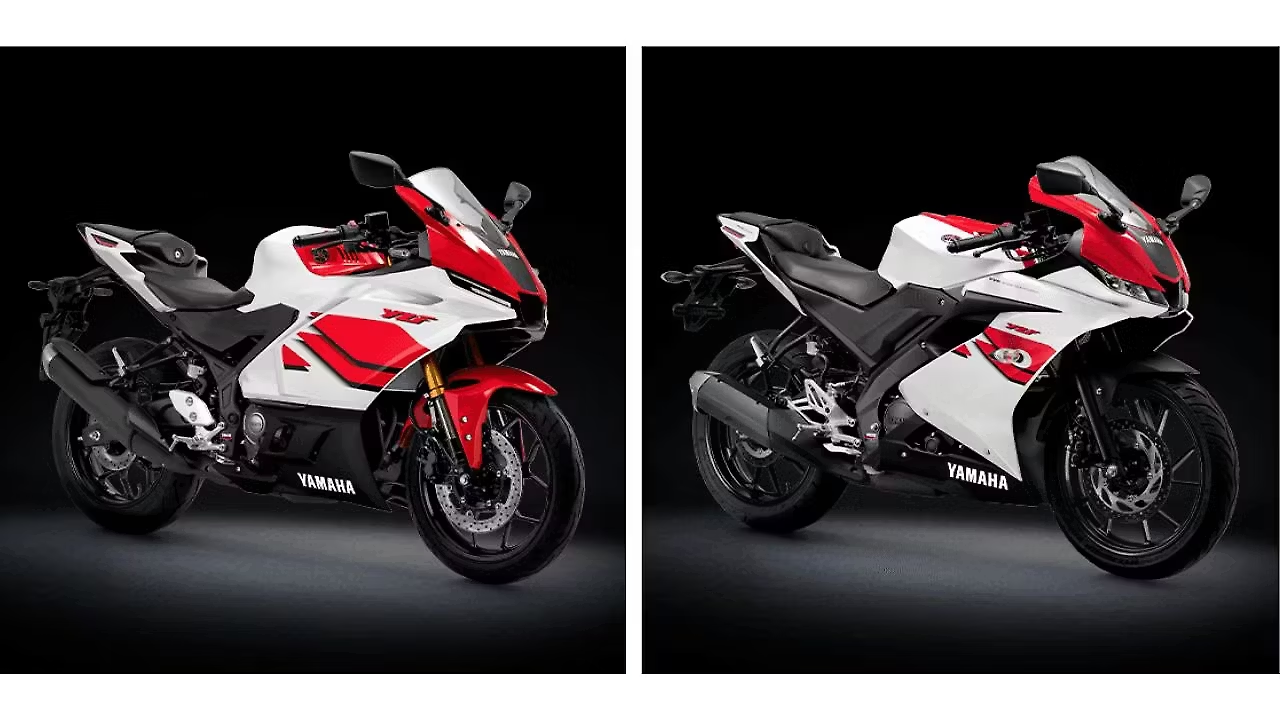
The livery: A white base with bold red panels flowing across the full fairing, fuel tank, and tail section. It's an immediately arresting colour scheme that looks nothing like any R3 currently on sale anywhere in the world.
3D tiled graphics: The side panels feature red-coloured tiles in a 3D format – these aren't flat decals. They have visual depth and texture that changes depending on the angle you're looking at the bike from. It's a subtle but effective design touch that adds premium character.
Black accents: Small black patches on the front fascia and lower fairing break up the red-and-white theme, preventing it from looking monotonous and adding visual layering.
Anniversary branding: A special 70th Anniversary logo sits on the fuel tank, while the standard Yamaha and R3 logos remain in their usual positions above the headlamp and on the tank. The anniversary badge is the clearest visual marker that this isn't a standard R3.
Everything else – the sculpted fuel tank, aerodynamic full fairing, split seat, large windscreen, and sporty exhaust system – carries over unchanged from the standard model.
Engine & Specs – Unchanged, and That's Fine
The R3 has always been about delivering a complete sportbike experience in an accessible package. The 70th Anniversary Edition continues that philosophy without modification:
| Specification Detail | |
| Engine | 321cc Liquid-Cooled Parallel-Twin |
| Valve Configuration | DOHC, 4-Valve |
| Power | 40.4 bhp @ 10,750 rpm |
| Torque | 29.4 Nm @ 9,000 rpm |
| Transmission | 6-Speed |
| Fuel Tank | 14 litres |
| Kerb Weight | 170 kg |
| Front Suspension | 37mm Inverted Forks |
| Rear Suspension | Linked Monoshock |
| Front Brake | 298mm Disc with ABS |
| Rear Brake | 220mm Disc with ABS |
| Mileage (Avg) | ~25 kmpl |
The 321cc twin remains one of the sweetest engines in the entry-level sportbike segment. It's smooth, rev-happy, and produces enough power to be genuinely thrilling on backroads without being intimidating for riders moving up from smaller bikes. The twin-cylinder configuration gives it a more engaging character compared to single-cylinder alternatives – there's a mechanical richness to how it builds power that singles can't replicate.
Dual-channel ABS, inverted forks, and linked rear suspension ensure the R3 handles with a precision that belies its entry-level positioning. It's a bike that teaches you sportbike fundamentals while being forgiving enough to learn on.
Yamaha R15 70th Anniversary Edition – Same Treatment, Different Scale
The R15 gets an identical visual treatment to the R3 – same red-and-white heritage livery, same 3D tiled graphics on the side panels, same 70th Anniversary badging on the fuel tank.
R15 Specs (Unchanged from Standard)
| Specification Detail | |
| Engine | 155cc Liquid-Cooled Single-Cylinder |
| Valve System | SOHC with VVA (Variable Valve Actuation) |
| Power | 18.1 bhp |
| Torque | 14.2 Nm |
| Transmission | 6-Speed |
| Front Suspension | Inverted Forks |
| Rear Suspension | Linked Monoshock |
| ABS | Dual-Channel |
| Mileage (Avg) | ~40-45 kmpl |
The R15 is arguably the more significant model for Indian enthusiasts because it's one of Yamaha's best-selling sportbikes in this market. The VVA (Variable Valve Actuation) system gives it a broader powerband than its displacement would suggest, and the overall riding dynamics are genuinely sportbike-like despite the modest engine size.
Production Numbers – This Is What Makes Them Special
Here's where the exclusivity factor kicks in hard:
| Model Global Production Availability | ||
| R3 70th Anniversary | 600 units | Select international markets |
| R15 70th Anniversary | 1,200 units | Select international markets |
| R7 70th Anniversary | Limited (unconfirmed) | Select markets |
| R1 70th Anniversary | Limited (unconfirmed) | Select markets |
600 units of the R3. Globally. That's not 600 per country – that's 600 total, spread across every market that receives them. To put that in perspective, Yamaha sells more R3s in a single month in some markets than the total anniversary production run.
The R15 gets 1,200 units, which is slightly more accessible but still extremely limited for a motorcycle that sells in the tens of thousands annually across Asia.
These production numbers essentially guarantee that the anniversary editions will become collector's items. Whether that translates to value appreciation is uncertain – motorcycle collectibility follows different rules than car collectibility – but the rarity is undeniable.
The Big Question – Will India Get Them?
This is what every Indian Yamaha enthusiast wants to know. And the honest answer, based on everything we've gathered from multiple industry sources, is: probably not, but there's a slim chance.
Here's why it's unlikely:
The R3's cold reception in India. The standard R3 is priced at ₹3.39 lakh (ex-showroom) in India, and sales have been lukewarm. At that price point, buyers have alternatives like the Kawasaki Ninja 300, KTM RC 390, and even Yamaha's own MT-03 that offer arguably better value propositions. The R3 hasn't found the large audience in India that it enjoys in markets like Brazil, Europe, and Southeast Asia.
Anniversary pricing would be even higher. A limited-edition bike with exclusive livery would inevitably carry a premium over the standard model – potentially pushing the price past ₹3.75-4 lakh. At that level, the audience in India shrinks further.
Limited allocation maths. With only 600 R3 units globally, even if India received an allocation, it would be a handful – perhaps 20-50 units at most. The logistics and marketing cost of importing such small numbers may not justify the effort for Yamaha India.
Here's why there's still hope:
India is one of Yamaha's most important markets globally. The R15 is one of Yamaha's highest-volume sportbikes worldwide, and India is a massive contributor to those numbers. Ignoring India entirely in a 70th-anniversary celebration would be an odd choice.
DriveSpark reported on May 13 that since India is a key market, enthusiasts are hopeful Yamaha may allocate a limited number of units for Indian buyers. Nothing confirmed, but the door isn't completely shut.
Brand-building value. Even if the anniversary editions don't generate significant direct revenue in India, they create buzz, social media content, and showroom footfall. Every Yamaha dealership that displays an anniversary R15 or R3 benefits from the halo effect.
Our assessment: The R15 70th Anniversary has a better chance of reaching India than the R3, given the R15's stronger sales base and higher brand relevance in this market. If Yamaha does bring either model, expect extremely limited numbers and a premium of ₹15,000-30,000 over the standard variant.
What This Means for Yamaha's Bigger Picture
The 70th Anniversary Editions are more than just paint jobs. They're a reminder of what Yamaha stands for as a motorcycle manufacturer – engineering excellence with a deep connection to racing.
In a market increasingly dominated by adventure bikes, electric scooters, and utilitarian commuters, Yamaha's decision to celebrate its anniversary with sportbikes specifically is a deliberate brand statement. The R-series is Yamaha's soul – from the R1 superbike down to the R15 beginner sportbike – and wrapping them in heritage racing colours reinforces that identity for a new generation of riders.
For Indian enthusiasts specifically, these anniversary editions serve as a reminder of what the Yamaha R-series represents: accessible performance with genuine racing DNA. Whether or not the anniversary models reach Indian showrooms, the standard R15 and R3 remain some of the best sportbike experiences available at their respective price points.
Should You Wait for the Anniversary Edition?
If you're in India and considering an R15 or R3: Don't wait. There's no confirmed India launch, and even if it happens, units will be extremely limited and likely snapped up within hours of announcement. Buy the standard model, enjoy it, and if the anniversary edition does come, you'll hear about it.
If you're a collector or Yamaha completist: Keep your ear to the ground. Follow Yamaha India's official channels. If an allocation is announced for India, be prepared to move fast – at 600 R3s and 1,200 R15s globally, hesitation means missing out.
If you're outside India in an eligible market: These will sell out. If the anniversary livery speaks to you, don't overthink it. The combination of limited production, heritage design, and proven mechanicals makes these bikes that will only become more interesting with time.
Final Thoughts
Seventy years of building motorcycles that make people's hearts beat faster. That's what Yamaha is celebrating with these anniversary editions. The red-and-white livery isn't just paint – it's a bridge between the company's first tentative steps onto the world racing stage and its current position as one of the most respected motorcycle manufacturers on the planet.
The R3 and R15 70th Anniversary Editions may never grace Indian showrooms. But their existence reminds us why Yamaha matters – and why, after seven decades, the brand still knows how to make riders feel something.
Happy 70th, Yamaha. Here's to 70 more.
For the latest bike launches, riding stories, and two-wheeler updates – keep visiting TechyRobber.com. Know a Yamaha fan? Share this with them – they'll appreciate the heritage story!