Here's how you know a motorcycle launch has been successful: when the biggest complaint isn't about the price, the engine, or the features – it's about the waiting period. The BMW F 450 GS, launched in India on April 23, 2026, has generated so much demand that buyers across major cities are now staring at wait times of up to 9 months. Deliveries officially begin from June 2026, and BMW dealerships are reportedly overwhelmed with bookings.
At ₹4.70 lakh to ₹5.30 lakh (ex-showroom) across three variants, the F 450 GS marks BMW Motorrad's entry into India's fastest-growing motorcycle segment – the middleweight adventure category. It goes up against the KTM 390 Adventure, Royal Enfield Himalayan 450, and Kawasaki Versys-X 300, but it does so with a distinctly BMW approach: refined engineering, premium electronics, and a new clutch technology that could change how people ride adventure bikes.
Let's get into everything this motorcycle offers.
Three Variants, Clear Positioning
BMW has kept the lineup simple with three well-differentiated variants:
| Variant Price (Ex-Showroom) Key Addition | ||
| Standard | ₹4,70,000 | Base variant, core GS experience |
| Exclusive | ₹5,00,000 | Quickshifter Pro, adjustable levers |
| GS Trophy | ₹5,30,000 | Easy Ride Clutch, tubeless cross-spoke rims, adjustable suspension |
The Exclusive is being called the sweet spot by most early reviewers – it adds the Quickshifter Pro (which makes gear changes significantly smoother) without pushing the price to GS Trophy levels. But if you plan to do serious off-roading, the GS Trophy with its Easy Ride Clutch and cross-spoke tubeless rims is the one to get.
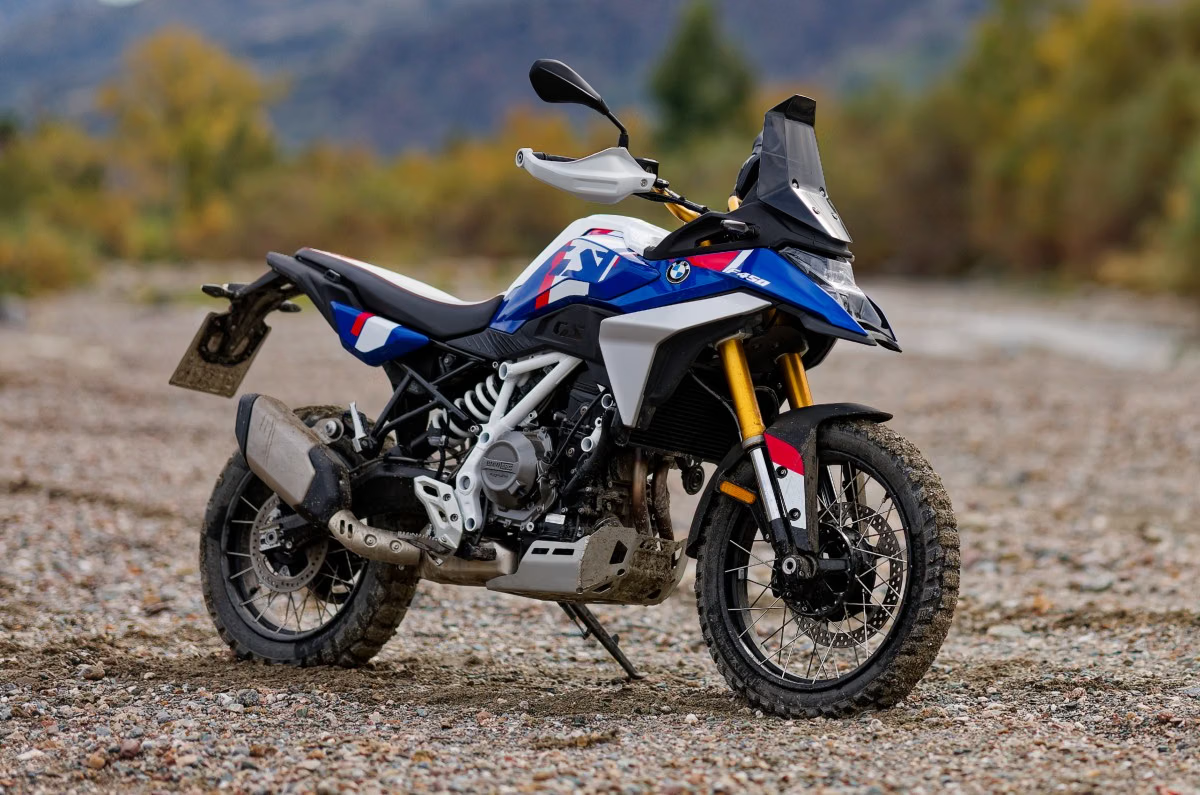
Colours: Available in Cosmic Black (Standard & Exclusive) and Racing Blue Metallic (across the range). The Racing Blue with its classic BMW Motorrad colour scheme is the one most people are drawn to.
The Engine – A Brand New 420cc Parallel-Twin
This is not a rebadged or borrowed engine. BMW developed an entirely new powerplant specifically for the F 450 GS platform:
| Specification Detail | |
| Engine Type | 420cc Liquid-Cooled Parallel-Twin |
| Firing Order | 135-degree |
| Power | 48 hp (47.94 bhp) |
| Torque | 43 Nm |
| Transmission | 6-Speed |
| Fuel Tank | 14 litres |
| ARAI Mileage | 26 kmpl |
| Real-World Mileage | ~23-24 kmpl |
The 135-degree firing order is a deliberate engineering choice. It gives the engine a slightly irregular firing pulse that creates better traction during off-road riding – the rear wheel hooks up more predictably compared to a conventional parallel-twin with a 180 or 270-degree crank. BMW describes it as "thrillingly rev-heavy," and early ride reports confirm that the engine loves being revved and delivers its power in a linear, usable manner.
48 hp might not sound like a lot on paper, especially compared to bigger adventure bikes. But in a motorcycle weighing just 178 kg, it translates to a power-to-weight ratio that's more than adequate for everything from city commuting to highway touring to light off-road trails.
The engine is also genuinely refined. NVH (Noise, Vibration, Harshness) levels are low for a twin-cylinder, and there's none of the buzzy vibration that plagues some competitors at higher RPMs.
Easy Ride Clutch – The Feature Everyone's Talking About
The Easy Ride Clutch (ERC), available on the GS Trophy variant, is arguably the F 450 GS's most innovative feature. It's a centrifugal clutch system that fundamentally changes how you interact with the motorcycle at low speeds.
Here's how it works: at low RPMs and during take-off, the clutch engages automatically. You don't need to use the clutch lever to pull away from a standstill. Just slot into first gear and roll on the throttle – the bike moves. In stop-and-go traffic, this is transformative. No more feathering the clutch at every traffic light.
But unlike a fully automatic system, the ERC retains the engine braking function when you're in overrun mode. So when you're descending a hill or decelerating, the engine brake works exactly like it would with a conventional clutch. This is critical for off-road riding where engine braking helps maintain control on steep descents.
You can also override the system at any time – the clutch lever still works normally. So experienced riders who prefer full manual control can have it whenever they want.
The Quickshifter Pro (standard on Exclusive and GS Trophy) complements the ERC perfectly. It allows clutchless upshifts and downshifts at speed, with smooth, mechanical-feeling gear changes. Upshifts are particularly satisfying – crisp and instant. Downshifts are slightly less seamless (some early reviewers note occasional clunkiness), but this could improve as the bikes get broken in.
Chassis, Suspension & Off-Road Capability
The F 450 GS inherits design DNA from its big sister, the legendary R 1300 GS, and you can see it in the chassis setup.
Frame: Steel tubular frame that's optimised for both rigidity and weight savings. At 178 kg kerb weight, the F 450 GS is lighter than the KTM 390 Adventure (182 kg) – which makes it noticeably easier to handle, especially off-road where every kilogram matters.
Suspension:
- Front: Gold-anodised 43mm KYB upside-down forks with 180 mm of travel. The GS Trophy variant gets adjustable rebound and compression damping
- Rear: KYB monoshock with Progressive Damping (WAD) that adapts to road conditions. Also adjustable on the GS Trophy variant
- Suspension feel: Set up slightly sportier than expected. It handles well on smooth roads but feels a bit firm on really bad surfaces. Not harsh, but not the plush BMW ride some expect
Wheels:
- Standard & Exclusive: 19-inch front / 17-inch rear alloy wheels with tubeless tyres
- GS Trophy: 19-inch front / 17-inch rear tubeless cross-spoke rims – these are the adventure-ready option, offering the strength of spoked wheels with the convenience of tubeless operation
Braking: Front and rear disc brakes with lean-sensitive ABS – the ABS adjusts its intervention based on the bike's lean angle, preventing lockups during cornering. There's also an off-road ABS mode that allows rear wheel locking for dirt riding.
Ground Clearance: Generous enough for light to moderate off-road work. The bike's slim profile and low centre of gravity make it confidence-inspiring on loose surfaces.
Electronics & Features
For a middleweight ADV, the electronics package is comprehensive:
- 6.5-inch TFT colour display – sharp, readable in sunlight, with ride statistics, live telemetry, call management, and map-based navigation
- 4 riding modes – Road, Rain, Dynamic, and Enduro (GS Trophy)
- Lean-sensitive traction control – adjusts intervention based on the bike's angle
- Lean-sensitive ABS with off-road mode
- Shift Assist Pro (Quickshifter) – Exclusive and GS Trophy variants
- LED headlamp with X-shaped DRL – inspired by the R 1300 GS, it's both functional and visually distinctive
- LED indicators and tail lamp
- Adjustable hand levers – brake and clutch lever reach can be customised
- Connected ride features – pair with BMW's app for additional data
- Heated grips (GS Trophy) – less useful in most Indian conditions, but appreciated on cold morning rides
What's missing (and noticeable): No cruise control and no TPMS (Tyre Pressure Monitoring System). Both are features that cheaper mass-market motorcycles now offer, and their absence on a ₹5 lakh+ BMW is puzzling. Heated grips made the cut but cruise control didn't – that's a prioritisation choice many riders will question.
Riding Impressions – What Early Reviewers Say
Based on published reviews and rider feedback from launch events:
Strengths:
- Engine is smooth, rev-happy, and delivers usable power across the range
- Easy Ride Clutch is genuinely transformative in city traffic
- Handling is nimble and confidence-inspiring – the 178 kg weight is noticeable
- Build quality and fit-finish are unmistakably BMW – a class above most rivals
- Electronics work flawlessly – no beta-testing feel, everything is polished
- TFT display with navigation is excellent
Areas for improvement:
- Suspension is firmer than expected – doesn't absorb bad roads as plushly as the bigger GS models
- Quickshifter downshifts can be slightly clunky on new units
- No cruise control is a genuine miss for a touring-oriented bike
- Seat could be more comfortable for very long rides
- 14-litre fuel tank limits touring range to approximately 320-340 km between fills
Competition – How It Stacks Up
| Model Price Engine Power Weight Key Advantage | |||||
| BMW F 450 GS | ₹4.70-5.30 L | 420cc Twin | 48 hp | 178 kg | ERC, electronics, build quality |
| KTM 390 Adventure S | ₹3.97 L | 399cc Single | 43 hp | 182 kg | Price, proven reliability, huge community |
| Royal Enfield Himalayan 450 | ₹2.85 L | 452cc Single | 40 hp | 196 kg | Price, dealer network, simplicity |
| Kawasaki Versys-X 300 | ₹4.70 L | 296cc Twin | 39 hp | 175 kg | Smooth twin, road-biased comfort |
| Honda NX500 | ₹5.89 L | 471cc Twin | 48 hp | 192 kg | Honda reliability, bigger engine |
The BMW's premium is justified if you value its electronics refinement, build quality, and the Easy Ride Clutch innovation. The KTM offers more bang-per-buck. The Himalayan offers the best value overall. The Honda NX500 (especially with the new E-Clutch variant at ₹7.44 lakh) is the closest rival in terms of philosophy and price.
9-Month Waiting Period – Should You Book Now?
The demand situation is real. As of May 14, 2026, waiting periods across major Indian cities are stretching to 9 months for popular variants. If you're serious about the F 450 GS, booking sooner rather than later is advisable – the wait is only going to get longer as word-of-mouth spreads.
Deliveries begin from June 2026. The Exclusive variant in Racing Blue Metallic is reportedly the most in-demand configuration.
Final Verdict
The BMW F 450 GS is not the cheapest middleweight adventure motorcycle you can buy. It's not even close. But it might be the most refined one. The engine is smooth, the electronics are polished, the Easy Ride Clutch is genuinely innovative, and the overall build quality sets a standard that rivals will need years to match.
The missing cruise control and TPMS are genuine oversights that BMW should address in a future update. The suspension setup could be softer for Indian conditions. And the 9-month waiting period means you'll need patience.
But if you test ride this motorcycle, you'll understand why 9 months doesn't seem that long after all. Some things are worth waiting for.
For the latest bike launches, riding gear reviews, and two-wheeler coverage – keep visiting TechyRobber.com. Know a rider who's been eyeing the F 450 GS? Share this with them!