
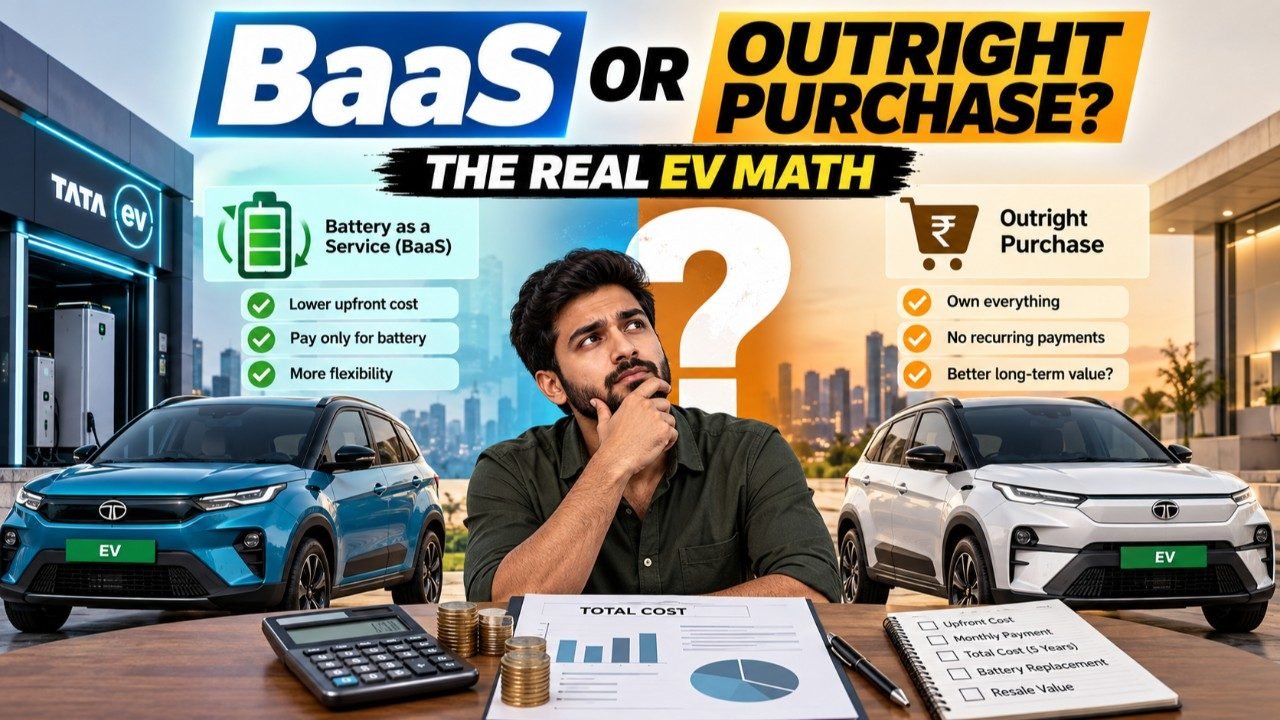
Every major EV brand in India now sells the same pitch: pay less upfront, pay for the battery separately every month. Tata just extended this to its entire range, from the Rs 4.69 lakh entry point up to the Harrier EV. Mahindra, MG and Citroen already run similar schemes. The lower number looks appealing standing in a showroom. Whether it actually saves you money depends on one calculation almost nobody does before signing.
How BaaS actually works
Tata physically separates the car and the battery at the point of sale. You finance the vehicle at a lower price and pay for the battery through a recurring monthly charge instead of folding its full cost into the upfront number. The battery, the single most expensive part of any EV, moves from a one-time cost into a subscription.
The upfront gap is real
Mahindra's XUV 9e drops from roughly Rs 21.9 lakh outright to about Rs 13.9 lakh under BaaS, with the battery running around Rs 4.90 per km. MG's Hector Tomahawk EV goes from Rs 19.49 lakh to Rs 13.99 lakh, at roughly Rs 2.26 per km. Citroen's eC3X Extended drops to Rs 6.99 lakh at Rs 2.26 per km. These are genuinely large gaps, often Rs 5 to 8 lakh less at the point of purchase.
Where the math actually flips
Here's the part that doesn't show up on a showroom brochure. At Rs 3-5 per km depending on the brand, the battery rental adds up fast if you drive a lot. Run 12,000 km a year for five years, and that is 60,000 km. At Rs 4 per km, the battery alone costs roughly Rs 2.4 lakh over that period, on top of the lower vehicle price you already paid.
Whether that adds up to more or less than buying outright depends entirely on three things:
- How many kilometres you actually drive. Low-mileage owners, driving under 8,000 km a year, tend to come out ahead on BaaS. High-mileage owners, especially daily long commutes, may end up paying more over time than they would have upfront.
- How long you plan to keep the car. The gap saved at purchase is fixed. The monthly cost keeps running for as long as you hold the BaaS arrangement. A three-year owner and a ten-year owner are doing very different maths on the exact same scheme.
- Whether you'd have taken a loan anyway. If you were financing the full price through an EMI regardless, the real comparison is battery rental versus battery-inclusive EMI interest, not "lower price versus higher price."
Why the industry has converged on this so fast
BaaS didn't stay a niche, entry-level feature. It has spread from budget models to full-range rollouts, including on flagship SUVs like the Harrier EV, in less than a year. That tells you something about what's actually happening: it is not really about affordability for the poorest buyers anymore. It has become a genuine pricing lever every brand wants available, because it lowers the sticker price that shows up in comparisons and ads, regardless of whether it saves the buyer money in the long run.
The honest bottom line
BaaS is a genuinely useful option for the right buyer: someone driving modest annual distances, not planning to keep the car for a decade, and who values a lower upfront number over long-term certainty. For a high-mileage buyer planning to keep the car for years, the outright price, even though it looks scarier on day one, is often the cheaper road in the end.
Before choosing either, actually run the numbers for your own driving pattern. Multiply your expected annual kilometres by the per-km battery rate, multiply that by how many years you plan to own the car, and compare the total against the price gap you're saving upfront. The answer is rarely the same for two different buyers, even on the exact same car.
Have a tip on India's auto and EV space? Write to us at contact@techyrobber.com