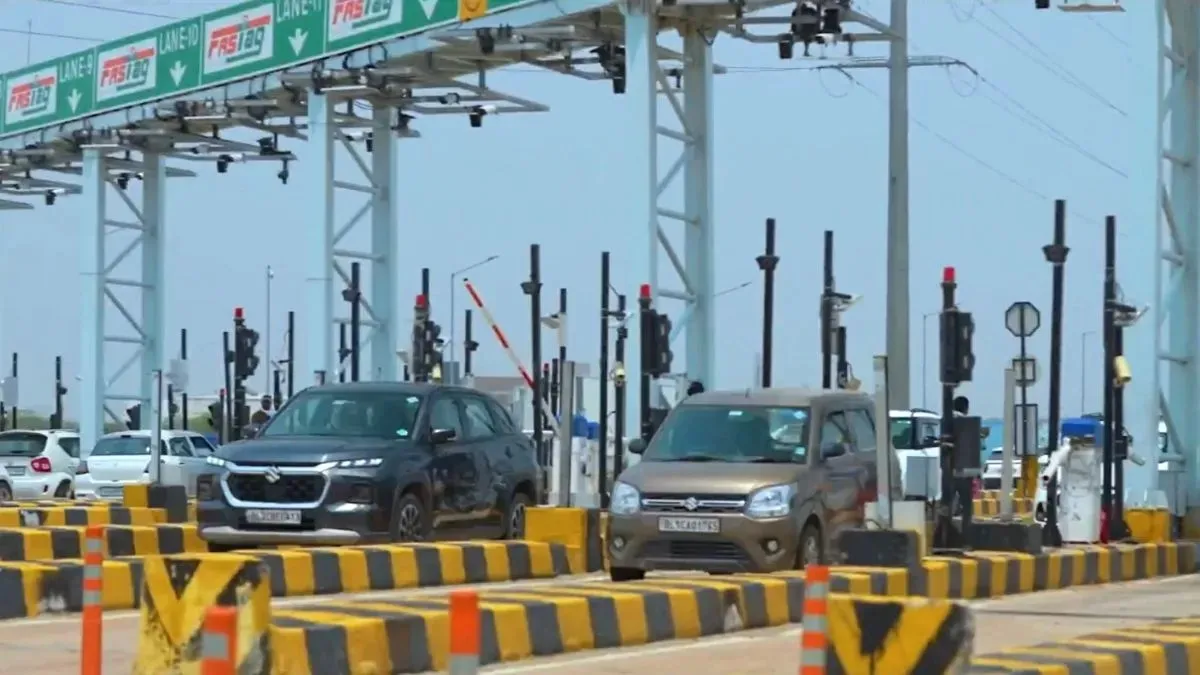
If you've ever driven on an Indian highway, you know the drill. You're cruising at 100 kmph, the road is clear, the music is perfect – and then you see it. A wall of red brake lights. The toll plaza. What follows is anywhere from 5 to 45 minutes of creeping forward in a queue, watching people cut lanes, fumbling for FASTag balances, and silently questioning every life choice that led you to this highway at this hour.
That experience might finally be dying.
On May 11, 2026, Union Minister for Road Transport and Highways Nitin Gadkari inaugurated Delhi's first-ever barrier-free toll plaza at Mundka Bakkarwala on the Urban Extension Road-II (UER-II). This makes it only the second Multi-Lane Free Flow (MLFF) tolling system in the entire country – the first was activated just days earlier at Chorayasi toll plaza in Gujarat on May 1.
The concept is straightforward: you drive through the toll point at highway speed, and the toll is automatically deducted. No barriers. No queues. No stopping. Your car is identified, your FASTag is charged, and you keep moving as if the toll plaza doesn't exist. Because, in a sense, it doesn't – at least not in the way you've known it.
How Does the Barrier-Free System Actually Work?
The magic behind this system is a combination of technologies working together in real time. There are no boom barriers, no toll booths, and no humans waving you through. Instead, overhead gantries are equipped with a stack of sensors and cameras that do everything automatically.
Here's the tech breakdown:
RFID + FASTag Detection
Your existing FASTag still plays a central role. As your vehicle passes under the gantry, high-speed RFID readers detect your FASTag and initiate the toll deduction. This happens in milliseconds – far faster than the current system where you have to slow down to 5-10 kmph for the reader to catch your tag.
Automatic Number Plate Recognition (ANPR)
This is the backup system – and it's a critical one. High-resolution cameras capture your vehicle's number plate as you pass through. If your FASTag fails, doesn't have sufficient balance, or isn't detected for any reason, the ANPR system kicks in. Your number plate is matched against the national vehicle database, and a toll notice is sent to the registered owner.
LiDAR Vehicle Profiling
This is the part most people don't know about. The system uses Light Detection and Ranging (LiDAR) technology to create a 3D profile of each vehicle passing through. Why? Because different vehicle classes pay different toll rates. A motorcycle is exempt. A car pays one rate. A truck pays another. LiDAR ensures the system automatically classifies your vehicle correctly without anyone needing to look at it.
Speed and Violations Detection
Here's where it gets interesting – and slightly scary for rule-breakers. Gadkari specifically mentioned that the MLFF cameras are capable of detecting whether drivers are wearing seat belts and whether they're using mobile phones while driving. These cameras work even at night. Violations are automatically captured and forwarded to the nearest traffic authority for challan issuance.
So the barrier-free toll plaza isn't just about toll collection – it's also functioning as an automated traffic enforcement system. Something to keep in mind the next time you reach for your phone on the highway.
What Happens If Your FASTag Doesn't Work?
This is the question everyone asks first, and it's a fair concern. India's FASTag system, while a massive improvement over cash collection, still has its issues – expired tags, low balances, reader failures, and mismatched vehicle registrations.
Under the MLFF system, here's the enforcement cascade:
Step 1: RFID reader attempts to detect and charge your FASTag. If successful, the toll is deducted instantly and you're done.
Step 2: If FASTag detection fails, the ANPR cameras capture your number plate. A digital toll notice is generated and sent to the registered vehicle owner via SMS and email.
Step 3: If the toll remains unpaid, NHAI's new e-notice recovery system (introduced under the National Highways Fee Second Amendment Rules, 2026) escalates the notice. Persistent defaulters can face penalties and even vehicle blacklisting.
The key thing to understand is that you won't be stopped or chased. The system operates on a trust-but-verify model. You keep driving. The technology handles the rest. But if you don't pay, the system will catch up with you – it just happens digitally rather than physically.
The Numbers That Matter
Gadkari shared some impressive figures during the inauguration that put this transition into perspective:
| Metric Detail | |
| Annual toll revenue (before FASTag) | ~₹40,000 Crore |
| Annual toll revenue (after FASTag) | ~₹55,000 Crore |
| Previous operating cost | ~15% of toll revenue |
| New operating cost (with MLFF) | ~10% of toll revenue |
| Annual savings from MLFF rollout | ₹5,500 – ₹6,000 Crore |
| Maximum vehicle speed through MLFF | 80 kmph |
That savings figure – ₹5,500 to ₹6,000 crore per year – is enormous. To put it in context, that's roughly the cost of building 500-600 km of new two-lane national highway. Simply by removing barriers and automating toll collection, the government frees up enough money to build actual road infrastructure. It's one of those rare government initiatives where the math genuinely works.
The National Rollout Plan – When Does Your City Get One?
Delhi's Mundka Bakkarwala and Gujarat's Chorayasi are just the beginning. NHAI has a phased plan to take this system nationwide:
Phase 1 – By September 2026
17 toll plazas across 9 states will be upgraded to the MLFF system. The confirmed states include:
- Gujarat
- Delhi
- Haryana
- Rajasthan
- Tamil Nadu
- Karnataka
- Maharashtra
- Assam
- (One additional state yet to be confirmed)
NHAI Chairman Santosh Kumar Yadav has confirmed that all 17 plazas are targeted to go live within this financial year.
Phase 2 – By March 2027
The bidding process for an additional 108+ toll plazas is already underway. These will cover states including Delhi, Gujarat, Rajasthan, and Telangana, with more expected to be added as the programme scales.
Long-Term Vision – Entire Highway Network
Gadkari's stated goal is ambitious but clear: make the entire national highway network barrier-free by the end of 2026. Whether that timeline is realistic given India's infrastructure execution track record is debatable, but the intent and early execution are promising.
MLFF vs GNSS – What's the Difference?
You might have heard about another toll technology that's been in the news – the GNSS (Global Navigation Satellite System) based tolling system. It's important to understand how these two relate to each other.
MLFF (Multi-Lane Free Flow): This is what's been launched at Mundka Bakkarwala. It uses fixed overhead gantries with RFID readers, ANPR cameras, and LiDAR sensors at specific toll points. You still pass through a defined toll location – you just don't stop.
GNSS-based tolling: This is the next evolution. Instead of fixed toll points, GNSS uses satellite tracking to monitor your vehicle's position on the highway. Toll is calculated based on the exact distance you've travelled – not based on passing through a specific point. Think of it like how Uber calculates your fare based on kilometres driven.
GNSS-based tolling is already being piloted at the Chorayasi toll plaza in Gujarat and has been tested on the Bengaluru-Mysuru and Panipat-Hisar national highways. When fully implemented, it would eliminate toll plazas entirely – not just the barriers, but the physical plaza locations themselves. You'd drive from Delhi to Mumbai on the expressway, and the toll would be calculated and deducted based on your exact entry and exit points.
The current MLFF system is essentially a bridge technology – a massive improvement over the old barrier system, but still dependent on fixed toll locations. GNSS is the endgame where even those locations become irrelevant.
For now, NHAI's approach is hybrid – rolling out MLFF at existing plazas while simultaneously developing GNSS infrastructure for a future transition. The GNSS mandate for commercial vehicles is expected in 2026-27, with private vehicles following later.
The Evolution of Toll Collection in India – A Quick Timeline
For context, here's how far we've come:
| Era System Pain Points | ||
| Pre-2016 | Manual cash collection | Massive queues, corruption, revenue leakage |
| 2016 onwards | FASTag (RFID) | Faster but still requires slowing/stopping, reader failures, balance issues |
| April 2026 | Zero-cash policy | Cash lanes eliminated, UPI accepted at 1.25x surcharge |
| May 2026 | MLFF (barrier-free) | No stopping at all, 80 kmph pass-through, automated enforcement |
| 2026-27 (planned) | GNSS (satellite-based) | Distance-based billing, no fixed toll points needed |
Each step has been a significant improvement, and the MLFF launch represents arguably the biggest single leap in the entire journey. Going from "slow down to 5 kmph" to "drive through at 80 kmph" is a fundamentally different experience.
What Drivers Need to Do Right Now
If you're planning to drive through a barrier-free toll plaza, here's what you should ensure:
1. Make sure your FASTag is active and linked correctly. The system relies primarily on FASTag detection. If your tag is expired, deactivated, or linked to the wrong vehicle, you'll receive a toll notice through the ANPR system – which means delays and potential penalties.
2. Maintain adequate FASTag balance. NHAI recommends keeping at least ₹500 above your estimated trip toll. If your balance drops too low, your FASTag can be blacklisted mid-journey, and you'll be charged double at the next plaza.
3. Ensure your number plate is clean and readable. ANPR cameras need to read your plate clearly. If your plate is damaged, faded, obscured by a fancy frame, or covered in dirt, the system may fail to identify your vehicle – leading to enforcement complications.
4. Follow traffic rules – seriously. The cameras are always watching. Seatbelt violations and phone usage will be detected and challaned automatically. This isn't theoretical – Gadkari specifically confirmed this capability during the inauguration.
5. Check if your route has an MLFF plaza. Currently, only Mundka Bakkarwala (Delhi) and Chorayasi (Gujarat) are live. But 17 more are coming by September 2026. The NHAI Rajmargyatra app can help you check which plazas on your route are barrier-free.
The Bigger Picture – Why This Matters Beyond Toll Collection
The barrier-free toll system isn't just a convenience upgrade for highway drivers. It represents a fundamental shift in how India approaches road infrastructure management.
Fuel savings: Millions of vehicles idling at toll plazas every day burn massive amounts of fuel for no productive reason. Eliminating that idle time means measurable fuel savings at a national level, which translates to lower emissions and reduced oil imports.
Logistics efficiency: India's trucking and logistics industry loses billions in productivity every year due to highway delays, and toll plazas are a significant contributor. Barrier-free tolling means goods move faster, supply chains become more efficient, and transportation costs potentially come down.
Revenue transparency: Automated digital collection leaves a complete audit trail. Every vehicle, every transaction, every timestamp – all recorded. This dramatically reduces the scope for revenue leakage and corruption that plagued the manual and even early FASTag systems.
Road safety enforcement: As mentioned, the MLFF cameras double as traffic enforcement tools. Over time, this could meaningfully improve highway driving behaviour – especially around seatbelt compliance and phone usage.
The Bottom Line
Delhi's Mundka Bakkarwala barrier-free toll plaza is a small beginning with massive implications. For the first time, Indian drivers are experiencing what highway driving feels like in countries where toll plazas are invisible – you just drive, and the system handles everything else.
The technology works. The savings are real. The rollout plan is aggressive but achievable. And if Gadkari's vision of a fully barrier-free national highway network comes to fruition by late 2026 or early 2027, it will be one of the most impactful infrastructure upgrades India has seen in decades.
For now, the next time you're on the UER-II heading through Mundka, don't slow down at the toll point. Just drive. The cameras will take care of the rest.
Welcome to the future of Indian highways. It's about time.
For more auto news, tech updates, and highway developments – keep visiting TechyRobber.com. If this article helped you understand the new toll system, share it with every driver you know!